

[Note: This article is a work in progress. I will update it as time allows, but I want to help people see that the greatest danger of Bethel Church is their false gospel, while all other issues are symptoms of that false teaching.]
After looking at the broad issues surrounding churches using music from Bethel, Hillsong, and Elevation, it’s essential to consider why these specific groups pose such a danger. After all, why should we be concerned about music sending people to a ministry that may get one or two things wrong? No one is perfect, right?
The remaining articles will reveal two major issues within each church: how they intentionally distort the Bible and how they preach a different Jesus. These warnings come in obedience to these New Testament passages:
Beloved, do not believe every spirit, but test the spirits to see whether they are from God, because many false prophets have gone out into the world. By this you know the Spirit of God: every spirit that confesses that Jesus Christ has come in the flesh is from God, and every spirit that does not confess Jesus is not from God. This is the spirit of the antichrist, of which you have heard that it is coming, and now it is already in the world. (1 John 4:1-3 LSB)
Therefore, beloved, since you are looking for these things, be diligent to be found by Him in peace, spotless and blameless, and consider the patience of our Lord as salvation, just as also our beloved brother Paul, according to the wisdom given him, wrote to you, as also in all his letters, speaking in them of these things, in which are some things hard to understand, which the untaught and unstable distort, as they do also the rest of the Scriptures, to their own destruction. You therefore, beloved, knowing this beforehand, be on your guard lest you, having been carried away by the error of unprincipled men, fall from your own steadfastness, but grow in the grace and knowledge of our Lord and Savior Jesus Christ. To Him be the glory, both now and to the day of eternity. Amen. (2 Peter 3:14–18 LSB)
The greatest danger to the church always comes from within. 1 John reminds us that it’s not enough for someone to talk about Jesus. They must confess Him. They must accurately represent who Jesus is. Likewise, 2 Peter warns us against those who twist the Bible. These destructive acts can only be done by those who have a form of godliness but deny its power (2 Timothy 3:5).
The issue isn’t using music from a church that differs on minor beliefs. Rather, these groups are dangerous because they teach a false gospel. Because they teach a false gospel, they go on to teach other dangerous or heretical doctrines. To support them is to support wolves in sheep’s clothing. These people may open a Bible and talk about Jesus, but anyone whom God saves under these ministries isn’t saved because of the teachers but despite them.
Table of Contents
- Why Should Christians Avoid Bethel Church?
- Unbiblical teaching on supernatural gifts and abilities
- Supernatural gifts and a false gospel
- Trying to explain the contradictions
- New Apostolic Reformation / Independent Network Charismatics
- Dominionism and the Seven Mountains Mandate
- Kenosis (or Christ’s self-emptying)
- What is the “kenosis”?
- Bethel’s teaching
- What “kenosis” can’t mean
- Faithfully understanding the “emptying”
- 1. Paul’s discussion of “emptying” was about Christ’s humility in becoming like us, not losing His divine attributes.
- 2. It’s natural to wonder how Christ’s incarnation actually worked
- 3. The kenosis was about God’s glory and our salvation
- 4. Jesus did come as a human
- 5. Jesus did live as God
- Summarizing the kenosis
- What’s the issue?
- Bad theology leads to a false gospel (again)
- God’s word must change to fit Bethel’s theology
- So Jesus said to them, “Truly, truly, I say to you, the Son can do nothing of his own accord, but only what he sees the Father doing. For whatever the Father does, that the Son does likewise. (John 5:19)
- Truly, truly, I say to you, whoever believes in me will also do the works that I do; and greater works than these will he do, because I am going to the Father. (John 14:12)
- Jesus said to them again, “Peace be with you. As the Father has sent me, even so I am sending you.” (John 20:21)
- The problem is twisting God’s word, not struggling to understand it
- Christ becomes the means, not the end
- Baseless assumptions and a touch of blasphemy
- Bethel fails to understand sin and perfect obedience
- Diminishes Christ’s actions to match His followers
- Confuses the meaning of Jesus’s anointing and “by the Spirit”
- Misses what we really do through the Spirit
- It’s yet another symptom of being dissatisfied with the true Christian life
- Grave soaking and the dangers of experimenting
- Holy laughter, aka “drunk in the Spirit”
- The Holy Spirit’s presence as gold dust
- Female pastors
- The Passion Translation
Why Should Christians Avoid Bethel Church?
When looking at any church or teacher, our first question should be, “Do they preach a true gospel and confess the true Jesus?” If not, nothing else really matters. To that end, the first two points of this article are the most important. Anything after “Supernatural Gifts and a False Gospel” shows how Bethel’s false gospel leads to more unbiblical teachings and practices.
Unbiblical teaching on supernatural gifts and abilities
The issue with Bethel isn’t that they believe God still grants supernatural gifts today. It’s hard to read the book of Acts without wondering if we should live similar lives as the apostles. John Piper is one of the most famous preachers today and has been open that he believes spiritual gifts exist today but must be exercised according to the Bible. The sticking point is that Bethel Church goes beyond the bounds of Scripture.
This section will show numerous examples of Bethel Church’s unbiblical teaching and practice of spiritual gifts. As you read these, ask two important questions:
- Are these the behaviors modeled by Jesus, the prophets, and the apostles?
- Are the regular failures and unverifiable “successes” what Jesus, the prophets, and the apostles experienced?
If the answer isn’t “yes” to both, then a core teaching of Bethel Church’s ministry is unbiblical.
Unbiblical examples of prophecy, healing, and tongues
Bethel has a school where people learn to use spiritual gifts as Bethel understands them. They list one of their goals as “Naturally Supernatural,” saying (emphasis mine):
“The school is designed to equip students not just to minister in the gifts of the Spirit but to live a supernatural lifestyle. You experience life-changing revelation about yourself and the world around you as you become aware of the Kingdom within you and are encouraged to be naturally supernatural by bringing heaven to earth wherever you go. We believe Jesus meant it when He taught us to pray “Your Kingdom come…on earth as it is in Heaven.”
The school website offers the free ebook “The Supernatural Ways of Royalty: Discovering Your Rights and Privileges of Being a Son or Daughter of God” by Bill Johnson and Kris Vallatton. In explaining one of the functions of prayer and prophecy, they say this (emphasis mine):
“In Hebrews 1:14 it says of the angels, “Are they not ministering spirits sent out to render service for the sake of those who will receive salvation?” The angels are there to make sure that the sons and daughters of the King come into their destiny and that the mission of the Kingdom actually happens. What many of us don’t realize is that we have a role in commissioning the angels.
Psalm 103:19-22 says: The Lord has established His throne in the heavens, and His sovereignty rules over all. Bless the Lord, you His angels, mighty in strength who perform His word, obeying the voice of His word. Bless, the Lord, all you His hosts, you who serve Him, doing His will. Bless the Lord all you works of His in all places of His dominion. Bless the Lord, oh my soul.
The angels heed the voice of His word, but the Church is His voice to declare that word on earth. I am proposing to you that the angels actually receive their commissioning from the prayers and prophecies of the saints. I don’t think we have to tell the angels what to do; I think we just need to pray and prophesy in the Name of the Lord, and when they hear the word of the Lord they go out and perform it. But we can only declare a word of the Lord that commissions the angels if we are under authority and therefore have authority to send them.”
One article on their school’s website begins by saying, “I knew a man who would know people’s secret sins the moment he laid eyes on them….. I know quite a few people who, from a young age, saw into the spiritual realm like you and I see into the physical realm. They see angels and demons constantly, without actively looking for them.”
There’s an infamous story about a group of students who found a 15-year-old having an asthma attack and allegedly spent over 5 minutes trying to heal him miraculously. One even ran home to get her Bible. An ambulance was finally called, and the young man died four days later. Adding to the heartbreak, the boy’s mother said people from Bethel visited and even prophesied that he’d be raised from the dead.
There’s a similar story about a group of students hiking when one fell down a cliff. Rather than seek help, the two students spent an hour trying to heal him and debating whether they should even call for help.
Some students lengthened a woman’s leg and removed her pain through a healing session that included dancing around her.
However, some insist there is proof of healing. Elizabeth Reisinger frequently shares miraculous healings on her Facebook page. One post includes a video of a woman who’d lost part of her pinky in a childhood accident. As people gather around and command the finger to grow, the crowd starts cheering and crying as they witness her finger grow to its full length. Reisinger also posted a “before” and “after” picture of the healed finger, which you can see below.

Notice the knuckle crease below the pinkies in each photo. They’re lined up in the “before,” but the knuckle crease on the “healed” finger in the second photo is significantly higher. Yet despite this obvious sleight of hand, healings like this are celebrated as proof of God’s miraculous healing power.
We also can’t forget the tragic story of Olive, the two-year-old girl at Bethel who died in her sleep. Rather than mourning as parents who lost a child in a sin-cursed world, Bethel’s theology led Olive’s parents to spend six days holding prayer and worship services, showing their faith in Jesus to resurrect their daughter. This was odd to many, yet not at all surprising since Bill Johnson teaches it’s always God’s will to heal. You can read my own thoughts during the event here. As with other healings that could be confirmed, Olive’s parents and Bethel Church had to move on and hold a funeral for a little girl who hadn’t been mourned for six days.
However, many in Bethel do claim to experience real successes that are truly miraculous.
- Bethel’s own “testimonies” page shares numerous stories of incredible healings.
- In his book “When Heaven Invades Earth,” Bill Johnson shares what happened when an evangelist in Africa visited a grieving family: “She [a 9-year-old girl] was raised up about 12 hours after her death because someone was full of the Holy Spirit. He overflowed with the resurrection power of Jesus that filled him while he was trying to comfort to the family!”
- In “The Supernatural Ways of Royalty,” Johnson and Vallotton share what is actively happening in the world today: “Armed with the power of the Holy Spirit and commissioned to represent the King’s Son, we are healing the sick, raising the dead, and displacing devils. This is resulting in paupers becoming princes and the kingdom of this world becoming the Kingdom of our God!“ Toward the end of the book, Kris Vallotton shares the miraculous healing power (and personal voice) of Jesus that eventually led to his salvation: “I cried out in desperation, ‘If there is a God, if you heal my mother, I will find out who you are and I will serve you the rest of my life!’ An audible voice answered, ‘My name is Jesus Christ and you have what you requested!” The next morning my mother woke up completely healed. Her psoriasis was gone!”
One thing these various miracles have in common is that they’re always offered as a story without any evidence. Researchers have even asked for proof of Bethel’s claims, getting a response like this: “‘Being able to verify physical healings through medical records retrieved before and after healing is a time-consuming process, and one that not every person is willing or able to pursue,’ Tesauro said, in a series of statements for Shasta Scout that were recently confirmed by current Bethel Communications Director Brad Everett.’ The same website linked above reports that GMRI has done controlled research, but their website shows a clear bias as people who want to show the medical field that miraculous healing is real.
Prophecy is just as misunderstood as healing. Here’s a moment of spontaneous prophecy where God shows the singer an uncoiling rope. People in the room are meant to take that prophecy to mean God is unraveling their stress. Note how this is indistinguishable from a psychological trick psychics use: “cold reading.”
Bethel even encourages their people to be willing to get prophecy wrong. Pastor Renee Evans shares a class she leads where she and students get together to “practice prophesying.” She proudly tells the congregation that they sometimes get things wrong in these meetings, but “that does not make people a false prophet” (despite Deuteronomy 18:21-22 clearly contradicting her). She tells everyone to ask God for a word for someone; if God doesn’t give one, they should just make one up. A former Bethel student shares similar experiences, saying, “Ninety-nine times out of a hundred, your prophecies are horrible misses. But you don’t remember them being a terrible flop — you remember the one time it worked.”
For the sake of space, I will briefly mention an unbiblical definition of tongues. Their beliefs state, “We believe in the baptism of the Holy Spirit, speaking in other tongues, and the operation of the nine gifts of the Spirit,” and Bill Johnson discusses praying in tongues here. You can see my thorough discussion about why biblical tongues are only human languages here.
What’s the issue?
Notice the trend in these examples.
- People say they have gifts never mentioned in Scripture, or they redefine those gifts we do see in the New Testament.
- Prophecy is subjectively defined by whoever uses it: vague cold readings, making things up, or giving commands to angels.
- Most healings and prophecies fail.
- When they fail, even if it harms another, that doesn’t make the healer or prophet wrong.
- Those that verifiably succeed are short-lived placebo effects, small things like a limb getting slightly longer, or outright deception.
- In the age of smartphones, dramatic healings and resurrections always happen at times when no one can see or record them.
To Bethel’s credit, they aren’t shy about these things, which gives us no shortage of examples. So, as we evaluate the handful of examples here and the many more available across the internet, we want to ask two essential questions:
- Are these the behaviors modeled by Jesus, the prophets, and the apostles?
- Are the regular failures and unverifiable “successes” what Jesus, the prophets, and the apostles experienced?
But the prophet who speaks a word presumptuously in My name which I have not commanded him to speak, or which he speaks in the name of other gods, that prophet shall die.’ Now you may say in your heart, ‘How will we know the word which Yahweh has not spoken?’ When a prophet speaks in the name of Yahweh, if the thing does not come about or come true, that is the thing which Yahweh has not spoken. The prophet has spoken it presumptuously; you shall not be afraid of him. (Deuteronomy 18:20-22 LSB)
God took prophecy in His name so seriously that any failed prophecy would earn the death penalty. Biblical prophecy has always been measured by its accuracy to confirm that the person truly speaks for God. Saying “God says” when God didn’t say it isn’t just getting it wrong; it’s blasphemy.
We never see an Old Testament prophet say something about Israel or the coming Messiah that they got wrong. Jesus didn’t prophesy anything without absolute confidence that it would come to pass. Likewise, places like 1 Corinthians 14:29 and 1 John 4:1 make it clear that genuine prophecy is never expected to be wrong.
When it comes to prophecy, Bethel equips their people to be the false prophets Jeremiah was warned about:
Then Yahweh said to me, “The prophets are prophesying lies in My name. I have neither sent them nor commanded them nor spoken to them; they are prophesying to you a vision of lies, divination, futility, and the deception of their own hearts. Therefore thus says Yahweh concerning the prophets who are prophesying in My name, although it was not I who sent them—yet they keep saying, ‘There will be no sword or famine in this land’—by that sword and famine those prophets shall meet their end! The people also to whom they are prophesying will be thrown out into the streets of Jerusalem because of the famine and the sword; and there will be no one to bury them—neither them, nor their wives, nor their sons, nor their daughters—for I will pour out their own evil on them. (Jeremiah 14:14-16 LSB)
This stuff matters. Bethel’s level of false prophecy isn’t just a simple misunderstanding. It’s dangerous and disastrous for the leaders and those who follow their false teachings. God does not tolerate people speaking for Him when He hasn’t spoken to them.
There’s also no concept of a failed healing attempt unless the healer wasn’t reliant on God, as seen when Jesus rebuked the disciples for being unable to cast out a demon in Matthew 17:14-21. Healings took place in front of others and were so miraculous and undeniable that onlookers were open to the gospel of the God they clearly represented. Likewise, we have no reason to believe that paralytics or lepers eventually reverted back to their ailments.
Supernatural gifts are central to everything Bethel does. They have ministries and an entire school dedicated to it. People cannot follow Bethel without getting swept up in this teaching.
And, as we’ve seen, that core belief of Bethel is unbiblical. It doesn’t align with what we’ve seen from the prophets, apostles, or the Jesus they claim to follow. And, most dangerously of all, this unbiblical teaching has found its way to the gospel they preach.
Supernatural gifts and a false gospel
All false teachers will inevitably preach a false gospel. While we can look at things like Bethel’s mission statement and see encouraging statements like this:
We believe in the Lord Jesus Christ, the one and only Son of God, was conceived of the Holy Spirit, born of the virgin Mary, and is God’s Anointed One, empowered by the Holy Spirit to inaugurate God’s kingdom on earth. He was crucified for our sins, died, was buried, resurrected, and ascended into heaven, and is now alive today in the presence of God the Father and in His people. He is “true God” and “true man.”
We can look just a bit further down and see this:
We believe in the victorious, redemptive work of Christ on the cross provides freedom from the power of the enemy – sin, lies, sickness, and torment.
Understand what is said in this short statement: at the cross, Jesus Christ died to redeem us from sin and torment (which I trust they mean in the traditional sense), but also lies and sickness.
Bethel’s over-emphasis on supernatural gifts demands that they preach a false gospel and confess a false Jesus. Let’s look at the gospel issues in their church doctrine statement, how they falsely teach evangelism, the means of salvation, and how we can know we’re truly saved.
Jesus saves us from lies
What lies did Jesus die to rescue us from? It’s ambiguous. But based on the context of Bethel Church’s focus on the supernatural, how Bill Johnson discusses lies, and the clear influence of the Word of Faith heresy on the church, we can get an idea of their understanding of Christ’s redemptive sacrifice under God’s wrath.
- In this 20-minute clip, these are lies created by a literal “spirit of deception” that makes us doubt our authority or holds our neighbors captive. It’s the lie that God can’t heal marriage or that someone can’t be successful in life. Before the ending prayer, he tells the congregation they need to receive grace from Jesus to expel these lies.
- This sermon talks about mental strongholds, which are lies that allow Satan to invade our thoughts based on interpreting 2 Corinthians 10:3-5 to mean those strongholds are personal thoughts and not unbiblical worldviews. Johnson says, “The renewed mind enables us to usher in the miraculous.” How? According to him, the renewed mind proves God’s will, and God’s will is for Heaven to be on Earth. Therefore, the renewed mind allows us to perform miracles to bring Heaven according to God’s will. Those lies also create anxiety and inhibit our ability to be artistically creative, which is vital because Zechariah 1 shows that God defeats worldwide demonic oppression through artists.
- Bill Johnson said, “The enemy lies to us to make problems appear bigger than the solutions we carry.”
- Kris Vallotton, Senior Associate Leader at Bethel, once preached, “That’s why I believe that Paul said ‘but especially that you would prophesy,’ because when you prophesy words become worlds and you’ve changed people’s destiny. You create things that are not and you call them as though they are. I believe that you could change history through prophetic proclamations. I believe that Daniel changed Israel’s history through prophetic proclamations.”
The Word of Faith movement teaches that our words and beliefs have power. Based on Bethel’s consistent teaching about our authority to command things in the name of Jesus (or to unshackle God so He can act), the only explanation is that they believe Christ’s sacrifice on the cross empowers us to stop believing the lies of Satan and his demons and instead live the supernatural life we’re called to.
Jesus saves us from sickness
At this point, we know what healing means at Bethel Church. However, it’s worth pointing out that Bethel Church doesn’t just believe Jesus can cure disease or even that Jesus gives people the gift of healing. Rather, they believe bodily healing is as central to the gospel as the forgiveness of sins. Placing healing in that category means that it’s an absolute and guaranteed part of the Christian life.
According to Bethel Church, the gospel of Jesus Christ is physical healing.
Bill Johnson said as much when he wrote, “How can God choose not to heal someone when He already purchased their healing? Was His blood enough for all sin, or just certain sins? Were the stripes He bore only for certain illnesses, or certain seasons of time? When He bore stripes in His body He made a payment for our miracle. He already decided to heal. You can’t decide not to buy something after you’ve already bought it.
Read that carefully and clearly. The brief mention of Christ’s death paying for sins is said in the midst of Him paying for all physical healing. Bill Johnson very clearly states Bethel’s understanding of Christ’s sacrificial death. They’ve defined the gospel they preach.
Johnson continues preaching this gospel of physical healing in this sermon clip, saying, “I refuse to create a theology that allows for sickness.” He claims that Paul’s thorn in the flesh is sickness, then says, “That’s a different gospel. Jesus didn’t model it, and he didn’t teach it. And Paul said you can’t change the standard [referring to Galatians 1:8].” To Bill Johnson, only a false gospel allows sickness to be God’s will.
He clearly states it again in a sermon clip on Bill Johnson’s official YouTube channel titled “Divine Health Is Your Inheritance.” He even claims, “Anytime an affliction gets more painful under prayer it’s because the anointing torments a demon. And the reason he’ll increase the pain is to try to bring fear to the person who’s sick and fear to the person who’s praying.” So all sickness is demonic, and anytime someone continues suffering under physical maladies it’s because the sufferer or the person praying needs more faith to overcome that demon.
Johnson remains consistent in his understanding of Christ’s work on the cross in another clip on his official channel: “I believe it is the provision of the Lord in His suffering on our behalf Jesus bore stripes in His body through brutal beating as an atoning work to deal with the power of sickness and disease.”
In the end, Johnson’s false gospel stems from the false Jesus he preaches. I’ll cover this in-depth when we talk about “Kenosis” in a future section, but here’s a summary of how one false teaching has led to a false gospel of physical healing:
- Jesus never did anything as God.
- Jesus did everything by the Spirit to model to us everything humans can do through the Spirit today.
- It was always Jesus’s will to heal those who came to Him.
- Therefore, it’s always God’s will to heal people today.
It’s always God’s will to heal today because it was always Jesus’s will to heal during His earthly ministry. We are given power from the same source to do the same things. Thus, part of the gospel is our “inheritance” to heal and be healed by others.
False evangelism and false assurance
Bill Johnson’s popular book “When Heaven Invades Earth” works under one fundamental assumption: true Christians should demonstrate the power of God in their lives. But he doesn’t mean the ability to turn from sin, please God, or live a life of holiness and surrender. To Johnson, the truest evidence of a person indwelt by the Holy Spirit is the manifestation of supernatural power.
David Shrock has a concise and honest review of the book. In the review, Shrock takes great care to conclude that the book is heretical, a charge none of us should ever make lightly. I’d like to share several excerpts from the book with a small bit of commentary to help us see just how twisted Bill Johnson’s understanding of the gospel truly is and why he and Bethel Church deserve such a title.
Jesus gave people the right to disbelieve it all if there was no demonstration of power upon His ministry. I hunger for the day when the Church will make the same statement to the world. If we’re not doing the miracles that Jesus did, you don’t have to believe us. (page 93)
Signs will always accompany a true gospel message. Any church not giving the gospel alongside miracles isn’t sharing a true, or at least complete, gospel. He doubles down on this toward the end of the book:
We must realize the sad truth—it is common for people to acknowledge the kindness of the Church and still not be brought to repentance. But power forces the issue because of its inherent ability to humble mankind.
Jesus said, “If I had not done among them the works which no one else did, they would have no sin.”
Is He saying that sin didn’t exist in the hearts of the Jews until He performed miracles? I doubt it very much. He is explaining the principle revealed in Peter’s repentance. Power exposes sin and brings people to a decision. When power is missing, we are not using the weapons that were in Jesus’ arsenal when He ministered to the lost. The outcome? Most remain lost. Power forces people to be aware of God on a personal level, and it is demanding in nature. (page 115, emphasis mine)
Why are people lost? Why aren’t our kids, friends, or neighbors being saved? Because we aren’t demonstrating the power of God through miracles. The word of God isn’t sufficient to call people to repentance. To Bill Johnson, the true power of the gospel is in the signs and miracles.
However, the supernatural isn’t just helpful in calling people to repentance. Bill Johnson says that God promises entire cities will repent if enough people perform miracles in them.
But there is another message contained in this story [in Matthew 11:20-26]. Tyre, Sidon, and Sodom would have repented had they been exposed to the same dimension of outpouring! Did you hear it? They would have repented! It’s a prophetic promise for today. Miracles on the streets of the “sin cities” of the world will cause them to repent! It is this secret that gives us access to the heart of these great cities! The San Franciscos and the Amsterdams, the New Orleans and the Rio de Janeiros of this world will repent […] if there is an army of saints, full of the Holy Ghost, walking their streets, caring for the broken, bringing the God of power into their impossible circumstances. They will repent! That’s a promise. They simply await those with the message of the Kingdom to come.
Powerlessness cancels that possibility, and in its place comes God’s judgment. (page 118, emphasis mine)
Again, Johnson clearly states that miracles don’t just help with the gospel; they are absolutely central to it. Performing enough miracles secures God’s promise to save entire cities.
But people don’t just need to witness God – they need to witness us. Everyone’s salvation hinges on whether we have enough faith to perform miracles, then go out to cities and perform enough of those miracles for God to keep His promise. Johnson’s language throughout the book doesn’t just call for us to be Christ’s representatives as we obey the Great Commission. According to Johnson, millions will be saved or lost based on whether we take hold of God’s promise.
The anointing Jesus received was the equipment necessary, given by the Father to make it possible for Him to live beyond human limitations. For He was not only to redeem man, He was to reveal the Father. In doing so, He was to unveil the Father’s realm called heaven. That would include doing supernatural things. The anointing is what linked Jesus, the man, to the divine, enabling Him to destroy the works of the devil. (page 75, emphasis mine)
Previously in the book, Bill Johnson wrote, “If He performed miracles because He was God, then they would be unattainable for us. But if He did them as a man, I am responsible to pursue His lifestyle.” He diminishes the power and godhood of Jesus by elevating us to the same level of power and authority as the God of the universe who took on human flesh. Thus, evidence of salvation is the ability to do what Jesus did.
God is our Father, and we inherit His genetic code. Every believer has written into his or her spiritual DNA the desire for the supernatural. It is our predetermined sense of destiny. This God-born passion dissipates when it has been taught and reasoned away, when it’s not been exercised, or when it’s been buried under disappointment.
The spirit of the antichrist is at work today, attempting to influence believers to reject everything that has to do with the Holy Spirit’s anointing. This rejection takes on many religious forms, but basically it boils down to this: we reject what we can’t control. That spirit has worked to reduce the gospel to a mere intellectual message, rather than a supernatural God encounter. It tolerates the mention of power if it’s in the past. Occasionally it considers that power is appropriate for people in far away places. But, never does this spirit expect the anointing of God’s power to be available in the here and now. The spirit of control works against one of God’s favorite elements in man: faith. Trust is misplaced as it becomes anchored in man’s ability to reason. (page 77, emphasis mine)
This is classic evidence of conditioning. Bill Johnson says that salvation gives us God’s (symbolic?) genetic code, with certain expectations of what we can do. He then closes off anyone who hasn’t experienced the supernatural or doubts Johnson’s claims by insisting that any dispute is from the antichrist. By going all-in on the supernatural being evidence of salvation, he claims that anyone who questions or doesn’t experience it is under the influence of Christ’s enemy.
It’s also worth noting that Johnson draws a line between intellect and experience. The book has a pattern of setting the reader against religion, and he often accuses religion of squashing our ability to live out a supernatural life as we’re meant to. Here, he makes it clear that truth isn’t what we know but what we experience. We must encounter God through the supernatural to truly live in a way that pleases Him. Anything less than that is just empty religion.
Pastor Surprise is an apostolic leader working with Rolland and Heidi Baker of Iris Ministries in Mozambique. During an evangelistic crusade in which he was preaching, a 9-year-old girl died, which threatened to end the series of meetings. The entire village was stricken with grief. The next day Pastor Surprise went to visit the family, and the child’s body was still in the hut where she had died the night before. As he was praying for the family, he happened to be holding the little girl’s hand. He was not praying for her to rise from the dead, yet after a few minutes the young girl squeezed his hand. She was raised up about 12 hours after her death because someone was full of the Holy Spirit. He overflowed with the resurrection power of Jesus that filled him while he was trying to comfort to the family!
A bottle is not completely full until it overflows. So it is with the Holy Spirit. Fullness is measured in overflow. When we get introspective, we restrict the flow of the Holy Spirit. We become like the Dead Sea; water flows in, but nothing flows out, and nothing can live in its stagnant waters. The Holy Spirit is released through faith and compassion, and faith and compassion are never self-centered. (page 72, emphasis mine)
Salvation can be evidenced without us even trying. A missionary in Africa was so filled with the Holy Spirit that He poured out of him, resurrecting a young girl. This is the sort of lifestyle Johnson claims should be standard for Christians.
Beyond that, being “filled with the Spirit” in Ephesians 5:8 now becomes a literal command that can be measured. This story and its teaching imply that a believer can have the Holy Spirit, but He may only partially fill them. We will only know we’re “filled with the Spirit” when the supernatural happens around us.
These examples, and many more to be found across Bethel’s teachings, share one thing in common. All of them place the greatest emphasis on the supernatural. The supernatural is required to give the gospel, and demonstrating enough of it even guarantees that people will be saved. And the supernatural lifestyle necessary to give the gospel is the same one that confirms our own salvation. If we truly have the Holy Spirit inside of us, we should always expect Him to work miracles through us. Based on Bethel’s teachings, this is the core of the gospel and salvation.
The prosperity gospel
The Prosperity Gospel is a false gospel that teaches Jesus died to grant us health, wealth, and prosperity in this life. We’ve seen Bethel emphasize the “health” part, but Bill Johnson demonstrates its entire teaching.
In one sermon clip, Bill Johnson says that the purpose of the gospel is to create inward change in us so that our future generations can gain physical blessings:
What does it look like to have a soul that is prosperous? It was dealt with in Third John verse 2: “I pray that you would be in health and prosper, even as your soul prospers.” So the target, the aim of the gospel, is to heal people on the inside. Jen’s word this morning was perfect during prayer time, healing people on the inside. And so, picture this: He says, “Those who fear the Lord, something happens on their internal world where things start getting healed.” And it becomes so significant that it prepares the next generation to be able to steward a vast inheritance of land.
In a similar sermon, he says the inward change from the gospel will impact our physical health and financial situation:
What does it look like to have bounty in the soul? In our intellect? It means that instead of anxiety and resentment and those kinds of things that plague our fault life, instead of those things taking root, we actually remain a creative expression of God in the earth. As soon as I become anxious over details of my life, as soon as I become worried and fearful over situations, as soon as I begin to entertain resentment and vindication and stuff on people, I lose my creative edge. And the thing the enemy fears the most, in many ways, is an accurate expression of who our God is as a creator through His people that are free to think out of a place of abundance and a place of divine health. The Lord would actually express His nature into culture, into society through people that are healed here and healed here, whole in these places of the soul. Now, from God’s perspective in the New Testament, He wants us bountiful here, but then He says, “May you prosper and be in good health.” In other words, what’s going on inside of you, let it shape your physical health, let it shape your emotional and mental health, but also let it shape your finances, your financial world.
Johnson also teaches the Prosperity Gospel in “The Supernatural Power of the Transformed Mind” (emphasis mine):
For many years I misunderstood the biblical concept of desire. Psalm 37:4 tells us: ‘Delight yourself in the Lord, and He shall give you the desires of your heart.’ Like many pastors, I foolishly taught that if you delighted yourself in the Lord, He would change your desires by telling you what to desire. But that’s not at all what this means. That verse literally means that God wants to be impacted by what you think and dream. God is after your desires. The word desire is made up of the prefix ‘de’ meaning ‘of,’ and sire meaning ‘father.’ Desire is, by nature, of the Father.
The bolded language is similar to other prosperity preachers. The idea is that our desires move God. He is waiting for our permission to act and give us what we desire as long as we have enough faith in Him. Yet Johnson takes it further by saying that our desires are “of the Father.” Of course, this ignores what God says about our hearts and the desires it creates:
The heart is more deceitful than all else and is desperately sick; who can know it? (Jeremiah 17:9)
With these teachings, we once again see the purpose and benefits of Christ’s death redefined. Our assurance of salvation depends on our improved health and wealth, not the perfect work of Jesus on the cross to secure our salvation. It’s just one more example of the false gospel coming out of Bethel Church.
What’s the issue?
What is the gospel?
Now I make known to you, brothers, the gospel which I proclaimed as good news to you, which also you received, in which also you stand, by which also you are saved, if you hold fast the word which I proclaimed to you as good news, unless you believed for nothing.
For I delivered to you as of first importance what I also received, that Christ died for our sins according to the Scriptures, and that He was buried, and that He was raised on the third day according to the Scriptures, and that He appeared to Cephas, then to the twelve. After that He appeared to more than five hundred brothers at one time, most of whom remain until now, but some have fallen asleep. After that, He appeared to James, then to all the apostles, and last of all, as to one untimely born, He appeared to me also. (1 Corinthians 15:1-8 LSB)
Bethel talks about Christ dying for sins yet redefines it to include dying for our physical healing and prosperity in this life. They add to the gospel to suit their greater desire for supernatural gifts. Not only do they promise something Jesus never died for, but Christ’s inconsistency with granting healing or prosperity undermines the effectiveness of His death to redeem us from our sins. Look at what God clearly teaches about what Christ’s brutal death purchased:
Who Himself bore our sins in His body on the tree, so that having died to sin, we might live to righteousness; by His WOUNDS YOU WERE HEALED (1 Peter 2:24)
He didn’t bear our illnesses. He didn’t die to save us from poverty. The innocent Savior took on the guilt of His people, suffering in our place so that we could be made righteous. His wounds healed our guilt before a holy God, nothing more and nothing less.
In addition to changing the gospel, they change what is required to give it. Bill Johnson clearly states that the supernatural should accompany the gospel and that no one should believe it unless miracles accompany the truth of Jesus.
And according to Paul’s custom, he went to them, and for three Sabbaths reasoned with them from the Scriptures, explaining and setting before them that the Christ had to suffer and rise again from the dead, and saying, “This Jesus whom I am proclaiming to you is that Christ.” And some of them were persuaded and joined Paul and Silas, along with a great multitude of the God-fearing Greeks and not a few of the leading women. (Acts 17:2-4 LSB)
According to Bill Johnson, the Apostle Paul gave an incomplete gospel because he only used Scripture to present the gospel.
What does God say about those who preach a different version of Jesus?
Beloved, do not believe every spirit, but test the spirits to see whether they are from God, because many false prophets have gone out into the world. By this you know the Spirit of God: every spirit that confesses that Jesus Christ has come in the flesh is from God, and every spirit that does not confess Jesus is not from God. This is the spirit of the antichrist, of which you have heard that it is coming, and now it is already in the world. (1 John 4:1-3 LSB)
It’s not enough to talk about Jesus. You must confess the true Jesus. Those who intentionally change the character and nature of Jesus Christ are not from God. They are false prophets.
How about those who twist God’s word to serve themselves?
Therefore, beloved, since you are looking for these things, be diligent to be found by Him in peace, spotless and blameless, and consider the patience of our Lord as salvation, just as also our beloved brother Paul, according to the wisdom given him, wrote to you, as also in all his letters, speaking in them of these things, in which are some things hard to understand, which the untaught and unstable distort, as they do also the rest of the Scriptures, to their own destruction. You therefore, beloved, knowing this beforehand, be on your guard lest you, having been carried away by the error of unprincipled men, fall from your own steadfastness, (2 Peter 3:14-17 LSB)
If a teacher or church spends decades twisting Scripture, it’s a sign they are more than misguided. It’s intentional. Distorting God’s word is the behavior of those who are untaught, unstable, and unprincipled.
But how should we respond to anyone intentionally changing the gospel?
But even if we, or an angel from heaven, should proclaim to you a gospel contrary to the gospel we have proclaimed to you, let him be accursed! (Galatians 1:8 LSB)
Paul’s strong language shows us how important the gospel is. We cannot be flippant about understanding it, nor can we hand-wave those who intentionally preach a different version of it. Embracing these accursed teachers is disastrous for the universal church, the local church, and individual believers. That’s why he warned Timothy against those who rise from within the church and try to lead others to a different gospel:
But know this, that in the last days difficult times will come. For men will be lovers of self, lovers of money, boastful, arrogant, blasphemers, disobedient to parents, ungrateful, unholy, unloving, irreconcilable, malicious gossips, without self-control, without gentleness, without love for good, treacherous, reckless, conceited, lovers of pleasure rather than lovers of God, holding to a form of godliness, but having denied its power. Keep away from such men as these. For among them are those who enter into households and take captive weak women weighed down with sins, being led on by various desires, always learning and never able to come to the full knowledge of the truth. (2 Timothy 3:1-7 LSB)
Bethel seeks after experiences. Their entire ministry centers around emotional experiences. They lead thousands astray by teaching them to do the same. What they say appears very godly, yet their understanding of the gospel, its delivery, and our assurance of salvation shows a lack of trust in its true power. Instead, they teach that the full reality of the gospel is only understood by our experiences.
Bethel says some good things on their official website. Some of Bill Johnson’s sermons have biblical truth in them. I also do not doubt that Jesus has saved people at Bethel church. But having an appearance of godliness isn’t the same as following the true Jesus.
Nathan Knight wisely wrote, “Stated Belief + Actual Practice = Actual Belief.” Bethel is a perfect example of this. They say some good things, and things like “Rediscovering Bethel” have even tried to address many criticisms against Bill Johnson and Bethel Church. But when we take those stated beliefs and hold them up against what else is said and done, we get a clear picture of what Bethel actually believes.
Beware of the false prophets, who come to you in sheep’s clothing, but inwardly are ravenous wolves. You will know them by their fruits. Are grapes gathered from thorn bushes or figs from thistles? Even so, every good tree bears good fruit, but the bad tree bears bad fruit. A good tree cannot bear bad fruit, nor can a bad tree bear good fruit. (Matthew 7:15-18 LSB)
Be on guard for yourselves and for all the flock, among which the Holy Spirit has made you overseers, to shepherd the church of God which He purchased with His own blood. I know that after my departure savage wolves will come in among you, not sparing the flock; and from among your own selves men will arise, speaking perverse things, to draw away the disciples after them. (Acts 20:28-30)
For such men are false apostles, deceitful workers, disguising themselves as apostles of Christ. And no wonder, for even Satan disguises himself as an angel of light. Therefore it is not surprising if his ministers also disguise themselves as ministers of righteousness, whose end will be according to their deeds. (2 Corinthians 11:13-15 LSB)
But false prophets also arose among the people, just as there will also be false teachers among you, who will secretly introduce destructive heresies, even denying the Master who bought them, bringing swift destruction upon themselves. And many will follow their sensuality, and because of them the way of the truth will be maligned. And in their greed they will exploit you with false words, their judgment from long ago is not idle, and their destruction is not asleep. (2 Peter 2:1-3)
The evidence is there: Bethel doesn’t believe in a true gospel. They don’t confess the true Jesus. They are the kinds of false teachers and false prophets the New Testament warns us against. The greatest danger to the church will always come from within, from those who appear godly yet want to lead people astray in the name of a false Jesus. Bethel Church is a perfect example of that danger.
Trying to explain the contradictions
Note that every single Bill Johnson clip I’ve linked to in this article has him wearing glasses. His son Eric has significant hearing loss. His late wife, Beni Johnson, passed away from cancer in 2022. Although Johnson addressed the reality of his truly difficult situation, his words in no way match what he’s spent years proclaiming from the pulpit, in books, or what he continues to preach.
Stated Belief + Actual Practice = Actual Belief. Because of Bethel’s actual beliefs, thousands who have trusted in Jesus’s sacrificial death to heal their diseases are left confused, lost, and questioning the strength of their faith.
Bethel has been producing “Rediscovering Bethel” where they try to explain or clarify many misunderstandings about their teaching. In one titled “The Theology of Sickness and Healing,” Bill Johnson and Dann Farrelly explain the claims of “It’s God’s will to heal everyone” are intentionally bold, but they don’t mean it. Johnson then says:
“I don’t want to create a theology around what didn’t happen. That’s a really big deal for me. My approach to the faith things is: I’ll tell people, I say listen, faith brings answers. Enduring faith brings answers with character. So sometimes we’re in a journey, we’re in a process, and the Lord is building. He’s building us. He’s not just doing something through us. it’s not just about the miracle or the deliverance or whatever it might be. It’s about people becoming like Christ and enduring faith is a part of that power, you know. The whole ‘baptism of the Holy Spirit for the purpose of power.’ Power was for the miracle but it was also for the endurance until the miracle came.”
I’d encourage watching the full video to understand how they justify all their past and present teachings. The bolded part above is Johnson clearly saying he only wants to focus on the successes and not try to understand why the gospel of Jesus Christ doesn’t always heal. The rest of that quote is valuable because it shows the lengths required to explain to his flock why their faith isn’t bringing the healing that Bethel promised them would come.
In the end, though, this backpedaling completely contradicts their belief that Christ’s death was sufficient to pay for every sin and every sickness. Once again, read how Bill Johnson claimed it’s always God’s will to heal. Was His blood enough for all sin, or just certain sins? Were the stripes He bore only for certain illnesses, or certain seasons of time? When He bore stripes in His body He made a payment for our miracle. He already decided to heal. You can’t decide not to buy something after you’ve already bought it.
As time has passed, Bill Johnson’s version of Jesus has proven He can’t heal His people. It turns out the stripes Jesus bore were for certain illnesses and certain seasons of time. To continue justifying this false gospel, Johnson can no longer overlook his own physical ailments, losing his wife to cancer, and the thousands of heartbroken people in his congregation and around the world who trust Jesus just as Bethel Church has taught them to.
The “Rediscovering Bethel” video was released in 2021 and seems to contradict much of the bold claims of Bethel Church. One could hope that they’ve at least stopped offering empty promises. But that’s not what happened. In early 2023, Bill Johnson released the sermon clip previously linked in this article titled “Divine Health Is Your Inheritance,” continuing to show that Bethel Church’s beliefs on healing remain contradictory and unbiblical.
New Apostolic Reformation / Independent Network Charismatics
There is a growing movement called the New Apostolic Reformation (NAR), a label created by C. Peter Wagner, who popularized it. Bethel Church rejects that association, saying, “We don’t belong to anything of that nature, but we heartily agree with many of the things some of our friends in different organizations are really pursuing.” Instead, they align with Independent Network Charismatics (INC). However, if you compare the beliefs of the NAR and Bethel’s preferred INC, they are almost indistinguishable. Both groups center around these core tenets:
- Continuation of apostles and prophets
- Dominionism and the “Seven Mountain Mandate”
- A form of Prosperity Theology attached to Dominionism
- People still receive supernatural revelation
- Signs, wonders, and miracles are normal for today
It’s important not to get too hung up on which group’s label we want to give Bethel. Movements like the NAR and INC provide useful umbrella terms to quickly describe a set of beliefs. Still, the most important thing to analyze is Bethel’s specific beliefs that align with these groups.
We’ve already taken a deep look at their belief that miracles are normal for today and redefining prophecy to teach that God still speaks outside of His word (supernatural revelation). Now, let’s look at two other core NAR/INC beliefs that drive much of what Bethel does.
Continuation of apostles
“Is Bill Johnson an Apostle?” In this 12-minute video, Bill Johnson and Dann Farrelly answer that question with a “yes” and give clear insight into what they believe an apostle is today.
I will include some quotes from the video with my own comments after each.
The way I look at the apostolic gift, the apostolic calling, is that both the apostle and the prophet have a position. Their position gives them a perception of heaven and how it’s to affect earth. It’s a culturizing role. ….. It has to do with perception; it has to do with impact. The pastor is moved by the needs of the sheep, as he should be. You don’t want him dreaming about, you know, 100 years down the road and you want him caring for the flock. And so he has a perception on the here and now, the pain of this person, the success of this one. Yes, and that’s a gift that God’s given him. It’s a position of perception, where the apostle and the prophet tend to see more future-type things. Wisdom enables us to see a structure, order, these steps bring about this result. And again, it’s not a more spiritual position, I don’t believe. I don’t think it’s a hierarchy but it’s a, it’s like you stand here, tell us what you see. You stand here, tell us. So the pastor says, “Well, I see these people are hurting.” The apostle says, “I see this is what God is building into the earth.”
To Johnson, an apostle is more like an entrepreneur or influencer. While a pastor focuses on the day-to-day needs of people, apostles look at the bigger picture and use their insights to lead the church into making a cultural impact. Elsewhere, he and others like him defend this by rightly pointing out that the apostles were earth-shakers who forever changed history. But because Bill Johnson believes the universal church is meant to conquer the world (as we’ll discuss in Dominionism below), he views apostles like himself as the ones who will lead the church in that calling.
Dann Farrelly: I would say that marks of true apostolic leadership are servanthood and humility; that should be part of it—the ability to endure suffering for the cause of the kingdom. We see signs and wonders are a part of it as well. I think Paul and Peter interpreted Old Testament scripture for their communities, you know, so there’s a measure of that.
Dann Farrelly rightly points out what we see about apostles in the New Testament. In a way, an apostle’s qualifications are similar to a pastor’s because many of them boil down to being a mature believer. However, like a pastor, the New Testament also gives us unique identifiers that set them apart from spiritually mature Christians.
Apostles performed signs and wonders.
The signs of a true apostle were worked out among you with all perseverance, by signs and wonders and miracles. (2 Corinthians 2:12)
Miracles are central to Bethel’s theology, and Bill Johnson isn’t shy about how prevalent they should be in the life of a Christian. However, there seems to be no evidence that Bill Johnson has ever performed a sign or miracle. At best, we see things like this where he leads the church in healing others of invisible maladies with no verifiable evidence. This is especially problematic since the apostles’ miracles were so clear, objective, and undeniable that onlookers had no choice but to conclude those men must represent God.
Apostles witnessed the resurrected Jesus.
When choosing a new apostle to replace Judas, there was an explicit requirement that no “apostle” today fulfills: “Therefore it is necessary that of the men who have accompanied us all the time that the Lord Jesus went in and out among us— beginning with the baptism of John until the day that He was taken up from us—one of these must become a witness with us of His resurrection.” (Acts 1:21-22).
An apostle had to be one who had witnessed the bodily resurrection of Jesus Christ. This is why Jesus appeared to Paul in Acts 9:1-8, later leading Paul to defend his apostleship by saying, “and last of all, as to one untimely born, He appeared to me also. For I am the least of the apostles, and not worthy to be called an apostle, because I persecuted the church of God. (1 Corinthians 15:8-9)
The marks of an apostle include undeniable miracles performed by someone who personally witnessed Jesus Christ after His resurrection. For all the humility and willingness to suffer that Bill Johnson may possess, he has neither performed miracles nor seen the resurrected Savior.
Promoting what the Bible warns against
Bill Johnson also wrote a book called “When Heaven Invades Earth, ” demonstrating his theology.
In this post-denominational era we are seeing an unprecedented movement of believers gathering around spiritual fathers (not gender specific). In times past we gathered around certain truths, which led to the formation of denominations. The strength of such a gathering is the obvious agreement in doctrine, and usually practice. The weakness is it doesn’t allow for much variety or change. At the turn of the Twentieth Century, the people who received the baptism in the Holy Spirit with speaking in tongues were no longer welcome in many of these churches, because most denominations held statements of faith cast in stone.
But now this gravitational pull toward fathers is happening even within denominations. Such a gathering of believers allows for differences in nonessential doctrines without causing division. Many consider this movement to be a restoration of the apostolic order of God. (When Heaven Invades Earth, page 86, emphasis mine)
This further explains Johnson’s understanding of apostles being cultural influencers. Rather than believers submitting to leadership in their local church, Johnson places high value on people from all churches and denominations rallying around spiritual fathers and mothers outside their church walls. To him, this proves that God is bringing the universal church back to the apostolic methods He originally designed.
Beyond undermining the value and intention of the local church, this raises two severe concerns. First, Bill Johnson encourages people to rally around certain Christian personalities, despite this New Testament warning:
Now I exhort you, brothers, by the name of our Lord Jesus Christ, that you all agree and that there be no divisions among you, but that you be made complete in the same mind and in the same judgment. For I have been informed concerning you, my brothers, by Chloe’s people, that there are quarrels among you. Now I mean this, that each one of you is saying, “I am of Paul,” and “I of Apollos,” and “I of Cephas,” and “I of Christ.” Has Christ been divided? Was Paul crucified for you? Or were you baptized in the name of Paul? (1 Corinthians 1:10-13)
Johnson claims this return to the “apostolic order” is meant to break down denominational divisions. Yet, he believes this must be accomplished through what we can only describe as the “Christian celebrity epidemic” in modern Christianity.
Second, he encourages people to look beyond what their local church may teach and find a spiritual father they want to follow. Once again, the New Testament gives us a clear warning against this:
For the time will come when they will not endure sound doctrine, but wanting to have their ears tickled, they will accumulate for themselves teachers in accordance to their own desires, and will turn away their ears from the truth and will turn aside to myths. (2 Timothy 4:3-4)
Bill Johnson praises our culture’s desire to latch on to a particular teacher they resonate with. God warns that this behavior will only worsen as Christ’s return draws closer.
When beliefs lead to action
Finally, it’s worth looking at what this unbiblical understanding of apostleship leads to. The video below is a gathering of apostles agreeing to cast out the literal “spirit of racism” using Gandalf’s staff from the Lord of the Rings movie.
After explaining their apostolic authority to make declarations and then explaining this iconic scene from the Lord of the Rings, they invite the church to join them in casting out the spirit. At the 4:46 mark, you see them actually act out this scene, slamming the wooden staff down three times and purging racism from the church once and for all.
Many Christians saw this and laughed. But it’s important to ask why this happened in the first place. What’s going on in Bethel and the movement they are part of to lead to this?
Ultimately, this is the danger of going beyond the confines of the Bible. When God’s word isn’t sufficient to tell us what is true, our fleshly interpretations will lead to fleshly behaviors. Reverence for God gives way to experimentation and experientialism. You must constantly come up with new and exciting things because the church’s very foundation is based on experiences. And, on rare occasions, they must rely on gimmicks like this to keep things fresh.
Apostolically reenacting a scene from a movie to purge the spirit of racism was probably very exciting. But what’s happened since? What happens next?
When someone misunderstands apostleship, everything that follows will be built on that unbiblical foundation. Sound biblical teaching and instruction is either misinterpreted or outright ignored. In its place is whatever feels right in the moment, even if it’s blasphemously done “In Jesus’s name.”
What’s the issue?
We’ve looked at the issues around a few specific problems with believing apostles are still around today. However, one quote from the Rediscovering Bethel video above shows the fundamental issue in Bethel:
Dann Farrelly: “We’ve [I think he means the universal church] been comfortable with pastors and teachers and evangelists, but we’re uncomfortable… and part of the church says prophets and apostles were a foundational gift that just was for a season and ended, and that now it’s the season of pastors teachers and evangelists. And we would say: no, that we don’t think that’s the way it is.”
Bill Johnson: “It doesn’t say that.”
Dann: “No, it doesn’t say that. I think they look around the lack of them and go ‘I guess they’re gone.’”
Bill Johnson insists the Bible doesn’t say that apostles were meant to be a foundation and not a role meant to continue. However, it very clearly does say that apostles were temporary:
So then you are no longer strangers and sojourners, but you are fellow citizens with the saints, and are of God’s household, having been built on the foundation of the apostles and prophets, Christ Jesus Himself being the corner stone, in whom the whole building, being joined together, is growing into a holy sanctuary in the Lord, in whom you also are being built together into a dwelling of God in the Spirit. (Ephesians 2:19-22 LSB)
Paul calls on the process of constructing a building to explain how God has designed the church. During construction, you begin by laying a unique piece called a “cornerstone” that must be cut perfectly because the rest of the building depends on its quality. After laying that cornerstone, you build a foundation from it. After the foundation is laid, you build the rest of the building on top of it.
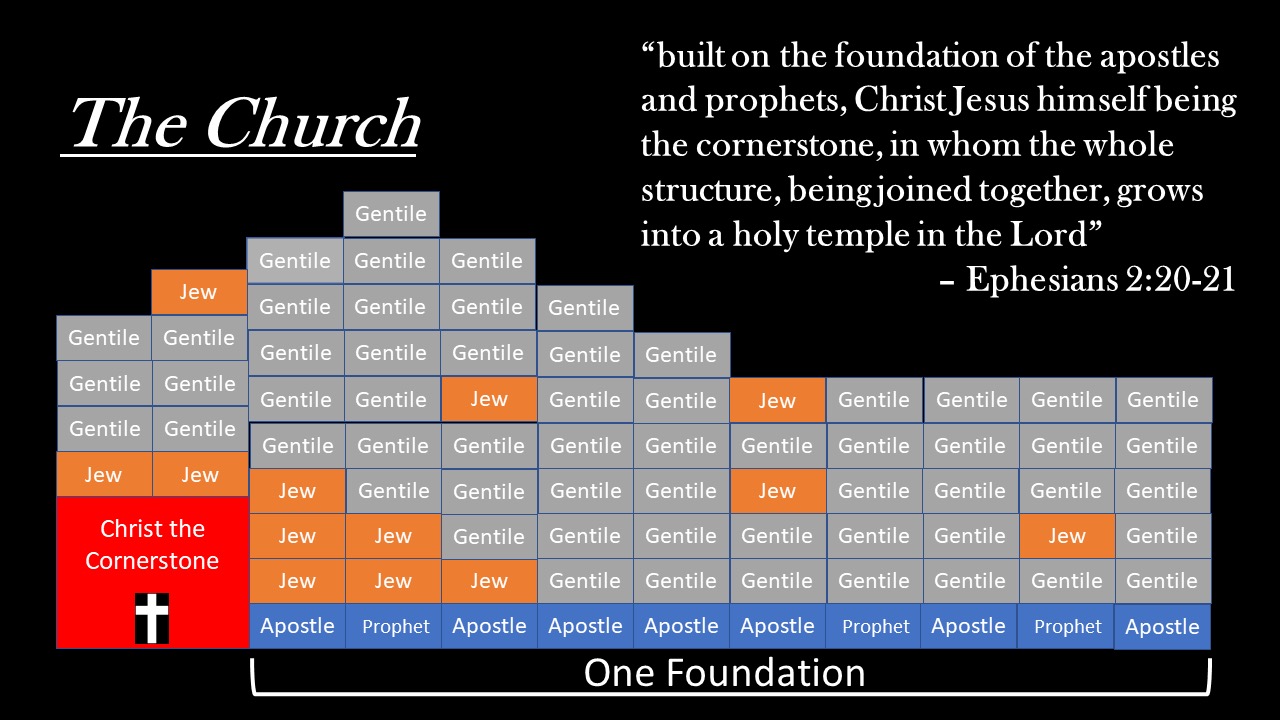
(Image credit to Chris Lenoir)
Like a cornerstone, Jesus Christ is unique. And like a foundation, the apostles only existed for God to build upon their work. But both Jesus Christ and the apostolic foundation are done being laid, just as a builder doesn’t lay another piece of foundation in the middle of a wall.
Like supernatural gifts, Bethel Church goes beyond what God teaches about apostles because they completely misunderstand its original function. We see ridiculous moments like the Gandalf staff because they aren’t acting as apostles and, therefore, have the freedom to make up whatever seems right to them at the time. Appealing to their alleged authority makes moments like banishing the spirit of racism seem significant, but it’s yet another experience in a long line of unbiblical experiences people continually show up for.
Bill Johnson and others worldwide aren’t apostles for many biblical reasons. But at the most fundamental level, they aren’t apostles simply because God is no longer laying a foundation for what He has been building for nearly 2,000 years. Insisting they are apostles, especially by claiming God’s word doesn’t say otherwise, is another instance of unbiblical beliefs leading to unbiblical actions.
Dominionism and the Seven Mountains Mandate
In the previous point, I mentioned that those of the New Apostolic Reformation (NAR) believe God commands them to conquer the world. This has historically been known as “Dominionism,” though it has been renamed (likely to remove the negative connotations that sound violent and aggressive). However, Bill Johnson affirms that he and Bethel are pursuing everything it stands for in both a Rediscovering Bethel episode and through his contributions to the book “Invading Babylon: The Seven Mountain Mandate.”
In its purest essence, Bethel believes that part of the “priesthood of the believer” requires us to conquer different “mountains” of society in the name of Jesus. These mountains are controlled by specific demons and are represented by many Old Testament tribes that Israel likewise had to conquer. Once the church has conquered these mountains and Christianity essentially controls the world, Christ’s eternal reign can begin. Put simply, Bethel believes Christianity must conquer the world to usher in Jesus.
What are these mountains, tribes, and associated demons?
| Mountain | Tribe | Demon |
| Media | Hittites | Apollyon |
| Government | Girgashites | Lucifer |
| Education | Amorites | Beelzebub |
| Economy | Canaanites | Babylon |
| Religion | Perizzites | Nameless “religious spirit” |
| Celebration (arts, entertainment, sports, fashion, etc.) | Hivites | Jezebel |
| Family | Jebusites | Baal |
As with other things we’ve discussed about Bethel, it’s easy to look at this and scoff. However, as with other things we’ve discussed about Bethel (defining worship, the prosperity gospel, how we view God’s promises…), we also see this thinking infiltrate biblical Christianity. This is especially prevalent in the United States, where we meld our Christian faith with a political party and think that our party winning means that Christ is winning.
Just consider this quote, and how it’s almost indistinguishable from how mainstream Christians discuss politics:
“It will bring God’s rule and reign to bear in places that have been dominated and devastated by evil powers of darkness.” – Johnny Enlow, The Seven Mountain Prophecy
Explaining the mandate
Here’s a quick rundown of how they defend this idea, as well as some underlying beliefs attached to it.
Mountains, tribes, and demons
Bethel believes that the church has replaced Israel. Thus, we should expect God to make demands of us that are comparable to what we see throughout the Old Testament. And as we see Israel entering into the Promised Land, they are commanded to conquer the various tribes before they can claim ownership of the land and establish their own kingdom.
Today, God likewise commands the “new Israel” to purge established evil from the world we will inherit, just as Israel inherited Canaan. But instead of battling human occupation, we wage spiritual warfare against “territorial spirits” who reign over certain aspects of society, infusing them with wickedness. Refer to the list again, thinking about how we see evil in each “mountain” and how God could be honored in those areas instead.
As for the territorial spirits, this is a mix of the war language we see in Ephesians 6, as well as what they identify as a “territorial spirit” in Daniel 10.
For we do not wrestle against flesh and blood, but against the rulers, against the authorities, against the cosmic powers over this present darkness, against the spiritual forces of evil in the heavenly places. (Ephesians 6:12 ESV)
[For context, Daniel is speaking to an angelic being who has come to deliver a message in response to Daniel’s prayer from several weeks ago. This messenger is now explaining why it took so long to arrive.] The prince of the kingdom of Persia withstood me twenty-one days, but Michael, one of the chief princes, came to help me, for I was left there with the kings of Persia, and came to make you understand what is to happen to your people in the latter days. For the vision is for days yet to come.”
So what are these spiritual forces of evil we’re wrestling against? According to Bethel, it’s territorial spirits like we see in Daniel 10. They are demons with a specific sphere of influence. As for how these particular spirits have been named (or left nameless, in the case of religion), it seems that recent apostles received divine revelation in which God identified these spirits for them.
Conquering through the Prosperity Gospel
One thing that sets the NAR apart from other false teachers is its understanding of the Prosperity Gospel. While the false teaching is still very self-focused, experiential, and unbiblical, it also plays into the Seven Mountains Mandate. Namely, in how we’re to use the blessings God promises to rain on us.
Conquering society isn’t cheap or easy. So when God blesses us with wealth, influence, or power, we are meant to steward those things toward dominating society. Yes, we should expect God to answer our prayers when we have enough faith, but we should also take our calling seriously and channel some of those blessings into ushering in Christ’s kingdom by waging war against the rulers of darkness.
Correctly understanding “conquering”
As I said, “Dominionism” has been rebranded. Yet even still, the language they use can create unease in those outside of Bethel. World history is filled with great acts of horror done in the name of religion. However, we need to evaluate Bethel’s beliefs fairly and see that they aren’t calling for anything violent, nor even unethical.
I think the best way to understand their goal is to think of it as “conquering evil through dilution.” Rather than violently overthrowing the government, education, or the media, they want to transform it from the inside. Victory will come when a Mountain is so filled with Christians that there simply isn’t room for the demon who rules it, squeezing out the demon and their earthly allies from power.
By how Johnson discusses it, we should note that their stated goal isn’t even necessarily for a church entity to control the government. Rather, the goal is twofold. First, for Christianity to be so attractive that people want to come to Jesus. Second, to benefit all of society because it’s better to have a Christian influence than a pagan or atheistic one.
It’s an idealistic goal, and one that assumes Christianity needs to be made attractive for people to come to Christ. Of course, this overlooks the fact that if God has always wanted Christianity to appear appealing from the outside, we should have seen the church operate in this way before the 1970s, when the Seeker Sensitivity movement began to gain momentum. Instead, while this is appealing to a Western (especially American) worldview where we are driven by entertainment and want people to earn our business, it shows a deep flaw in Bethel’s theology.
God isn’t sovereign and needs our help
Influenced by how the seeker-sensitivity movement is man-focused and functionally removes God from the equation, the Seven Mountains Mandate likewise operates as though God isn’t sovereign. Instead, God tells us what He desires (conquering the world) and then leaves it up to us to either succeed or fail. Again, this appeals to us because we love devising innovative strategies and programs that give us control over our success. Even churches filled with true believers too often fall victim to this very American mentality.
But here’s how Bill Johnson exemplifies the fatal flaws of this thinking. In discussing whether God is in control or just in charge, he says the following (emphasis mine:
Not everything that comes at us is God’s will. We have confusion; one of our biggest areas of confusion in the church concerns the sovereignty of God. We know that God is all-powerful; we know that he is in charge of everything, but with that, we make a mistake in thinking he is in control of everything. There’s a difference from being in charge and being in control.
If you think God is in control of everything, then you have to believe that Hitler was His will—that He was just going to work it for His purposes. Why would God raise something up as His will, and then empower you to pray against it? That would be a split personality: the Father working against the Son, the Son working against the Father.
God has created a system where humanity gets to live, and through partnership, we demonstrate and manifest His dominion on the earth. He comes at our invitation because He has released dominion to us. That’s why prayer is essential. Many of the great saints in history believed that God’s hands were, so to speak, ‘handcuffed,’ but released through prayer—released into a situation through partnership with delegated authority on earth, giving Him permission to come.
Now, He’s God of everything, ruler of everything, and He can step onto the stage anytime He wants. But as C.S. Lewis said, when the Author steps on the stage, the play is over. If you want Him to step on the stage, realize that the moment He does, it is over, and everybody’s choice ends where it is.
So, if you believe God is in control of everything, then you have to look at crisis and tragedy and say, ‘Well, He allowed it for a purpose.’ No. He didn’t allow it for a purpose. He put us in a realm where our authority and will have an effect on what happens around us. That doesn’t mean we walk in guilt and shame for tragedy, but it does mean we take responsibility on the earth.
Here’s the question I often ask people: How many storms did Jesus bless? How many life-threatening storms did He redirect and say, ‘Now go destroy that city. It will humble them, it will teach them to pray, they’ll become more like Me’? The church’s response to crisis is often, ‘Well, God worked it for good.’ Yes, He can use anything for good—that’s our trump card—but that doesn’t mean it was His will or His purpose.
If the Lord approves everything, then it’s really difficult to believe Him to change it. There’s an idea that God creates problems just so He can fix them to show us how strong He is. But He’s not an egomaniac. So, if God didn’t orchestrate the storm, why did it happen? My question is: Who did He leave in charge? Who did He give His name to? Who did He give His authority to? Who did He give a model to follow? He gave us, written in Scripture, how the Son of God lives. And He said, ‘As the Father sent Me, so I send you.’”
To avoid making this sub-point an article on its own, I will simply quote the Bible and offer a few comments:
Woe to Assyria, the rod of my anger; the staff in their hands is my fury! Against a godless nation I send him, and against the people of my wrath I command him, to take spoil and seize plunder, and to tread them down like the mire of the streets. (Isaiah 10:5-6)
Look among the nations, and see; wonder and be astounded. For I am doing a work in your days that you would not believe if told. For behold, I am raising up the Chaldeans,
that bitter and hasty nation, who march through the breadth of the earth, to seize dwellings not their own. (Habakkuk 1:5-7)
and the LORD said, ‘Who will entice Ahab, that he may go up and fall at Ramoth-gilead?’ And one said one thing, and another said another. Then a spirit came forward and stood before the LORD, saying, ‘I will entice him.’ And the LORD said to him, ‘By what means?’ And he said, ‘I will go out, and will be a lying spirit in the mouth of all his prophets.’ And he said, ‘You are to entice him, and you shall succeed; go out and do so.’ Now therefore behold, the LORD has put a lying spirit in the mouth of all these your prophets; the LORD has declared disaster for you.” (1 Kings 22:20-23)
There is a problematic theme that runs throughout Bethel’s theology: They are so insistent about unbiblical teachings that they would rather forsake God’s word than their preferred beliefs. Now, as far as false teachers go, this doesn’t surprise us when we read Paul’s words:
For the time is coming when people will not endure sound teaching, but having itching ears they will accumulate for themselves teachers to suit their own passions, and will turn away from listening to the truth and wander off into myths. (2 Timothy 4:3-4)
Despite the demands of Bethel’s beliefs, Scripture is filled with examples of God using evil people and events for His own ends. Unlike what Johnson implies, God doesn’t work all things for good by taking a bad situation and making the most of it. Instead, we see that He specifically raised up people like the Assyrians and Chaldeans to exact His judgment. He ordained that a lying spirit would be His means of making a wicked king fall. God doesn’t pick up the pieces left by evil people – He sovereignly uses evil without ever being the “author of sin.”
To claim that God isn’t sovereign is to bring Him down to our level. It’s what allows false teachers to claim that we give God “permission” to come and act in a situation. He isn’t on a leash that we tighten or loosen based on our will and the power of our prayers.
“Our God is in the Heavens. He does all that He pleases” (Psalm 115:3). Whatever God Bill Johnson worships is clearly not the true God of the Bible. But it is a weak, impotent God that allows the New Apostolic Reformation to promote the Seven Mountains Mandate, because their version of Christ can only come when we’ve done all the work for Him.
Seeing it in action
Consider some of the things Bethel is known for. Their music, which is the focus of this series, is one way they’re living out this supposed mandate from God. They make high-quality, appealing music that stirs up our emotions and makes us want more and more. Unlike charges we can level against much of Christian entertainment, Bethel music isn’t content to be an off-brand version of something better. They have set out to dominate the mountain of music, and the Christian world has participated in this conquest, whether they know it or not.
However, we also see this play out in their services. When I first started researching Bethel, I was flabbergasted to see people painting on stage or performing interpretive dance while others sang. But, again, this is a natural outflow of their belief that we need to conquer all areas of the world. Painting and dancing are just one way they wage war against the demon Jezebel, re-conquering the mountain of “celebration.”
We also see it in business. Bethel Church resides in Redding, California. In a town of 90,000 people, 11,000 of them attend the church. In 2020, it was the 5th largest employer in its county. They aren’t performing hostile takeovers or employing dirty business practices – they’re simply spreading out from the church as they believe God commands.
What’s the issue?
Several underlying issues lead to a teaching that sounds appealing, but at its core is wholly unbiblical.
First, it dangerously blends replacement theology[1] with the Prosperity Gospel’s greed and Pentecostalism’s over-emphasis on demons. It takes its marching orders from misapplying an Old Testament narrative, the result of which is primarily driven by its roots in the New Apostolic Reformation. It appears to use the Bible, but does so in a way that demands interpreting the Bible in a way that serves Bethel’s theology, rather than setting their theology under the authority of God’s word.
Second, it takes Bible verses and places a lot of assumptions on what they mean. They correctly associate Ephesians 6 with Daniel 10, but then filter them through the extra-biblical beliefs of Pentecostalism and how they define territorial spirits. They assume that the war language about the “world’s rulers” means that we must conquer what they rule, rather than understanding that we live in a broken world that they rule until Christ returns as the conquering king (read Zechariah 14, Matthew 25:31-46, or Revelation 19 to see how the world is certainly not conquered before Christ’s return).
Third, it reveals its hand by showing the clear (and unbiblical) influences of the Seeker Sensitivity movement. They argue that God has designed the church to operate in a way that wasn’t seen in the first 1,900+ years of the church. Though the Seven Mountains Mandate isn’t strictly evangelistic, they justify it in the same way they do with the Prosperity Gospel, and it’s the same pragmatic logic used throughout modern churches: If people think our stuff is exciting, they’ll love Jesus. Of course, this ignores the fact that Jesus Himself condemned people who wanted to follow Him to satisfy their material desires (John 6:26-27).
Finally, it’s just plain blasphemous. The belief that underlies all of Dominionism is that God needs us to do what He cannot. This belief doesn’t have us participating in God’s work in the same way that a child “helps” a parent fix their car or cook dinner. Instead, God waits around for us to permit Him to do His work. We release Him to work in specific situations, in entire spheres of influence, and eventually, we’ll do all the work to conquer the world for Him and pave the way for His return. The God of Bethel Church is simply not the God of the Bible.
Above all, this is not an example of “good Christians with bad doctrines.” This is yet another symptom of a much deeper issue that we’re examining. It’s yet another way that those without the Holy Spirit can take God’s word and twist it to such a degree that it completely changes who God is.
These are the sorts of people Paul warns us about when he says:
I am astonished that you are so quickly deserting him who called you in the grace of Christ and are turning to a different gospel— not that there is another one, but there are some who trouble you and want to distort the gospel of Christ. But even if we or an angel from heaven should preach to you a gospel contrary to the one we preached to you, let him be accursed. (Galatians 1:6-8)
This article is part of a discussion specifically about why we cannot invite false teachers into our musical worship of God. However, we must also recognize that this extends beyond music. If we aren’t careful, we’ll let false teachers redefine the mission of Christ’s church, as well as the very nature of God Himself.
[1] While I don’t believe the church has replaced Israel, that specific belief doesn’t make someone a false teacher. The problem is how Bethel adds to it.
Kenosis (or Christ’s self-emptying)
Kenosis, or Christ’s Emptying
One of the better-known issues at Bethel Church is Bill Johnson’s beliefs about the “kenosis” of Jesus Christ (or what Philippians 2:7 means when it says He “emptied Himself” when He came to the earth). Before continuing, I want to highlight the importance of showing grace with anyone’s explanation of this doctrine. The Bible doesn’t give us a detailed explanation of the actual mechanisms behind God Himself coming down from Heaven and taking on flesh. For the few faithful theories Christians have developed over the centuries, we may never know everything involved in Jesus living as 100% God and 100% man.
I argue we may never fully grasp it because it’s so outside of our own experience, and thus we have nothing to liken it to. Just like we can faithfully say things like “God has always existed,” we don’t know exactly what that entails because there’s nothing else in creation we can compare His eternal existence to. It’s true, but we can’t understand what it’s actually like. Compare that to statements like “God is omnipotent (all-powerful)” or “God is love,” and even though we may not fully grasp the extent of His omnipotence or love, we do understand those traits enough to grasp a fraction of what the Bible means when it describes Him that way.
So, as I said, I want to show reasonable grace to Bill Johnson because it’s very easy to poorly explain what happened when Christ “emptied Himself.” But, as we’ll see, even taking a measured approach to evaluating Bethel’s beliefs reveals dangerous beliefs.
What is the “kenosis”?
As I said, this is what we understand about what Paul means when writing to the church in Phillipi:
but emptied himself, by taking the form of a servant, being born in the likeness of men. (Philippians 2:7)
We call it “kenosis” because of the Greek word kenoō, which means “to make empty.” And although this passage is the only one that uses this specific word regarding Jesus, the concept of what Paul is talking about is seen elsewhere:
For even the Son of Man came not to be served but to serve, and to give his life as a ransom for many. (Mark 10:45)
And the Word became flesh and dwelt among us… (John 1:14a)
By sending his own Son in the likeness of sinful flesh and for sin, he condemned sin in the flesh (Romans 8:3b)
For you know the grace of our Lord Jesus Christ, that though he was rich, yet for your sake he became poor, so that you by his poverty might become rich. (2 Corinthians 8:9)
But we see him who for a little while was made lower than the angels, namely Jesus, crowned with glory and honor because of the suffering of death, so that by the grace of God he might taste death for everyone. (Hebrews 2:9)
The question isn’t “is kenosis heretical?” because the Bible is clear that some kind of emptying happened. The question we must wrestle with is “What does it mean that Christ emptied Himself and took on flesh?” We ask this question regarding the actual function of His emptying (i.e., what was He actually emptied of?), as well as how we should respond to this reality.
First, let’s look at Bill Johnson’s consistent explanation for Christ’s nature and what it means for Christians today.
Bethel’s teaching
Simply put, Bill Johnson believes that Jesus functionally lived His earthly life as a man. I say functionally, because Bill Johnson and Dann Farrelly have recently tried to clarify that they don’t believe Jesus ceased to be God while on the earth. Rather, they say they believe that He remained fully God but lived with all the limitations of a man, without any of the privileges of God, so He could show us what we can do if we fully surrender to the Holy Spirit.
Bill Johnson has written a few statements that give us clarity into what he teaches, and therefore what Bethel as a whole believes and practices.

In 2012, he wrote, “If Jesus Christ performed His earthly miracles as God, I stand amazed. But if He did them as a man dependent on God, I am compelled to follow His lead.”
This simple statement encapsulates Johnson’s core beliefs and what seems to drive the vast majority of Bethel’s work. He believes that Jesus’s self-emptying was, at least in large part, meant to show us that we are to live the supernatural, miracle-laden life of Jesus Christ. But it’s not just a one-off statement on social media. He said something similar in a 2016 sermon titled “Hosting the Presence” at the 7:22 mark.
He was consistent with this belief in an article for Charisma Magazine:
While Jesus is eternally God, He emptied Himself of His divine powers and became a man (see Phil. 2:7). It’s vital to note that He did all His miracles as a man, not as God.
If He did them as God, I would still be impressed. But because He did them as a man yielded to God, I am now unsatisfied with my life, being compelled to follow the example He has given us. Jesus is the only model for us to follow.
And later in the same article:
Jesus was clothed with the power of the Holy Spirit at His own water baptism, where, as a man, He had His personal encounter with the Holy Spirit (see Luke 3:22; John 1:32). Now the disciples would need the same.
The article’s main topic is the power and authority of believers to perform miracles. Nestled within this teaching is this foundational justification for that belief: that Jesus “emptied Himself of His divine powers,” allowing (or requiring) Him to perform miracles as a man. The reasoning for this is man-focused – He did it to show us what we’re supposed to do. I must emphasize that Johnson doesn’t explain what it means that Jesus emptied Himself of divine power, but he seems to assume that Paul’s statement that Jesus “emptied Himself” must be talking about His divine power (even though, as we see in Philippians 2, Paul says nothing about this emptying being His “divine powers,” whatever that might mean to Bill Johnson).
Johnson writes similarly in his popular book “When Heaven Invades Earth: A Practical Guide to a Life of Miracles.” It’s worth noting that Johnson has acknowledged that his language here has caused problems, but as we’ve seen, this book isn’t the only time he’s made statements like this. Thus, while attempting not to put words in Johnson’s mouth, this problematic wording isn’t a matter of an editor not catching a clumsy phrase. Instead, this is something he has repeated several times (emphasis mine):
Jesus lived his earthly life with human limitation. He laid his divinity aside as he sought to fulfill the assignment given to him by the Father to live life as a man without sin and then die in the place of mankind for sin. This would be essential in his plan to redeem mankind. The sacrifice that could atone for sin had to be a lamb( powerless), and had to be spotless (without sin).
Again, Johnson has recently clarified that he’s not saying Jesus ceased to be God. Nevertheless, he makes a twofold assumption that goes beyond mere wording: Jesus removed His divinity (or “divine attributes”) from Himself, and therefore lived a supernatural life that any other human is capable of. He subtly reinforced this by saying that Jesus had to be a powerless lamb. I’m sure Johnson would clarify that no human but Jesus could have lived the sinless life that made Him an acceptable sacrifice, though it’s difficult to determine how Jesus did this if He wasn’t the perfect God.
Johnson begins chapter 2, “Commission Restored,” with this (emphasis mine):
Jesus could not heal the sick. Neither could He deliver the tormented from demons or raise the dead. To believe otherwise is to ignore what He said about Himself, and more importantly, to miss the purpose of His self imposed restriction to live as a man.
Jesus Christ said of Himself, “The Son can do nothing.” In the Greek language that word nothing has a unique meaning—it means NOTHING, just like it does in English! He had NO supernatural capabilities whatsoever! While He is 100 percent God, He chose to live with the same limitations that man would face once He was redeemed. He made that point over and over again. Jesus became the model for all who would embrace the invitation to invade the impossible in His name. He performed miracles, wonders, and signs, as a man in right relationship to God … not as God. If He performed miracles because He was God, then they would be unattainable for us. But if He did them as a man, I am responsible to pursue His lifestyle. Recapturing this simple truth changes everything… and makes possible a full restoration of the ministry of Jesus in His Church.
He repeats this later in chapter 12 (emphasis mine):
For us to become all that God intended, we must remember that Jesus’ life was a model of what mankind could become if it were in right relationship with the Father. Through the shedding of His blood, it would be possible for everyone who believed on His name to do as He did and become as He was.
The logic is simple: if Jesus ever acted as God, then His lifestyle is unattainable. Conversely, if He functioned throughout His entire life only as a man, then His followers can do everything He did. Not only that, but as my final quote highlights, this supernatural Jesus-modeling is part of the gospel. Bill Johnson is clear that part of the gospel involves Jesus facing the brutality of the cross so that we can live a supernatural lifestyle. Thus, just as believers should expect to see the fruit of the Spirit as evidence of their salvation (Galatians 5:22-25), those whose sins have been paid for with the blood of Jesus Christ should see evidence of their salvation by performing signs and miracles.
It’s worth pausing here to remember that Bill Johnson, as God’s image-bearer, deserves to be fairly judged. Whatever other beliefs he may have, we don’t want to accuse someone of blasphemy if they don’t deserve it.
Above, I linked a “Rediscovering Bethel” episode where Johnson and Farrelly try to set the record straight that they don’t believe Jesus stopped being God. Yet even though he doesn’t clarify what he does mean by Jesus emptying Himself of divine attributes, what has Bill Johnson consistently demonstrated through his actual teachings? Despite attempts to prove he’s within biblical orthodoxy, he teaches that we can do everything Jesus did. Part of Bethel’s gospel demands that genuine Christians must model Him in the supernatural. After all, that’s what He died for, and we should expect Jesus to accomplish everything He set out to do.
Bill Johnson and those in his camp use other verses to justify this belief. For the sake of space, I will simply address them in the “What’s the issue?” section below.
What “kenosis” can’t mean
As I said at the beginning, there are a handful of theories that offer faithful understandings of exactly what Jesus set aside and how He lived His life as a man. And while we may not know which is the most accurate, there are some things we should be mindful of when evaluating any theory of the kenosis. That’s because many attempts to explain this haven’t just been wrong; they’ve actually changed who God is. So let’s discuss what Christ’s emptying can’t mean so that we can better evaluate the claims of Bethel and, hopefully, anyone else trying to explain this complex concept.
First, it cannot mean that Jesus stopped being God. Simply put, God cannot cease to be who He is any more than He can make a human a fourth member of the Trinity. God, as an eternal being (Psalm 90:2), is unchanging in His nature (Malachi 3:6, Hebrews 13:8) and indivisible in His essence (Deuteronomy 6:4, John 10:30), and thus cannot stop being God.
Likewise, it cannot mean that Jesus removed one or more attributes from Himself. Though coming in the limited form of a human, He didn’t lose any part of His divine nature by taking on a human nature. Theologians call this mystery the “hypostatic union,” meaning that Jesus had both a human and a divine nature at the same time, with neither competing with the other nor blending into a third nature. Jesus maintained all of His attributes at all times (Hebrews 13:8).
A third explanation we must avoid is to claim that Jesus had a sort of amnesia, forgetting He was God until later on in His life. Although His human nature suffered the typical developmental needs we’d expect (learning to walk and talk, feed Himself, and even going through some trial and error in carpentry), we also see that He understood His divine nature as a child (Luke 2:49). If that’s confusing, and even frustrating, get through one more paragraph and I’ll address this.
It also can’t mean that Jesus acted only as a man, without ever accessing His divine attributes or rights. I’ll delve deeper into the “why” of this later, because while Bill Johnson has recently sought to remain within the biblical boundaries of kenosis, what he teaches would, in practice, imply that Jesus was more like a Spirit-filled prophet who just happened to live a perfect and obedient life. A summary of the issues this presents is, simply put, that we do see Jesus act as God during His time on the earth.
There are other cautions we may need to take, but this at least sets the boundary for how we try to understand how Jesus, the eternal God of the universe and second member of the Trinity, could take on a human nature. With some of these, we may get frustrated because “if it can’t mean this, what else could it mean?” But this is where we need to tread with reverence to God, recognizing that while He has revealed much about Himself in the Bible, there are some things we simply cannot understand. Thus, we must avoid “comfortable” answers that diminish or change some aspect of who God is. If the Bible has revealed something about God, sometimes we must accept it as a “divine mystery,” or a revealed truth about God that humans just cannot understand.
Faithfully understanding the “emptying”
Throughout Christian history, there have been numerous “confessions” (statements intended to teach or clarify a biblical belief) that have summarized a faithful understanding of who Jesus is as both fully God and fully man. There have also been several scholars and theologians who have done extensive work to faithfully and biblically understand what this means. For our purposes, I’m not going to make a definitive declaration on what this emptying actually was beyond what the Bible clearly reveals. Instead, I’d like to set up some guard rails that will not only protect us from creeping into heresy, but also give us a means of evaluating how others try to explain it.
I’ll warn you, this is lengthy. But what Bethel believes about the incarnation of Christ is foundational to their version of the gospel and explains why they do the vast majority of the things they do. Thus, it’s fitting that we slow down and carefully think through the kenosis so we can better appreciate the danger of Bethel’s interpretation.
1. Paul’s discussion of “emptying” was about Christ’s humility in becoming like us, not losing His divine attributes.
who, though he was in the form of God, did not count equality with God a thing to be grasped, but emptied himself, by taking the form of a servant, being born in the likeness of men. (Philippians 2:6-7)
It’s easy to read Paul’s words and get distracted by the singular phrase “emptied Himself,” stirring up all sorts of questions and wonder in our minds. Many discussions have been held, and theologies developed about what Paul might be saying about Christ’s nature. It can even be frustrating because Paul says so little else to explain what he’s saying about Christ’s nature.
Except that Paul is actually fairly clear. The problem is that his point is far less exciting than we may prefer. Look at the fuller context:
So if there is any encouragement in Christ, any comfort from love, any participation in the Spirit, any affection and sympathy, 2 complete my joy by being of the same mind, having the same love, being in full accord and of one mind. 3 Do nothing from selfish ambition or conceit, but in humility count others more significant than yourselves. 4 Let each of you look not only to his own interests, but also to the interests of others. 5 Have this mind among yourselves, which is yours in Christ Jesus, 6 who, though he was in the form of God, did not count equality with God a thing to be grasped, 7 but emptied himself, by taking the form of a servant, being born in the likeness of men. 8 And being found in human form, he humbled himself by becoming obedient to the point of death, even death on a cross. 9 Therefore God has highly exalted him and bestowed on him the name that is above every name, 10 so that at the name of Jesus every knee should bow, in heaven and on earth and under the earth, 11 and every tongue confess that Jesus Christ is Lord, to the glory of God the Father. (Philippians 2:1-11)
Note the text that I bolded: these are all commands Paul is giving to this church. Reading these commands, we can imagine that this church had pride issues. People likely thought they deserved a certain amount of honor or respect, and perhaps even considered some members beneath their notice. These commands are like a sandwich, where Paul starts with “be of the same mind” and ends with “have this mind among yourselves.” The “meat” of this sandwich shows how Paul wanted them to be united in love, humility, and service to one another.
The text I underlined explains Paul’s reasoning: Jesus Christ, our God and Savior, humbled Himself. The One who truly deserves all honor, worship, and glory didn’t leverage His rights as God to ignore those who don’t deserve anything from Him but judgment.
Instead, the One who deserves our obedience became the one who obeys.
The king became a servant.
The source of life experienced death.
This resulted in Christ’s glory as our Savior. He is the one who will have others kneel before Him and voice His worthiness. Jesus has always been worthy of worship, yet for a time He humbled Himself for our sakes (2 Corinthians 8:9).
Paul’s point has nothing to do with addressing the mechanisms behind Christ’s incarnation. His goal wasn’t to make us build a theology of how much of Christ changed, nor is Paul in any way saying Christ “lost” something or spent His earthly ministry acting in a way that we are to mimic. This rich passage has two essential points for Paul’s audience.
First, he’s essentially saying “be like Jesus,” but it’s not about the “exciting” stuff. He’s showing the utter foolishness of those who think they are too good to love and serve their brothers and sisters in Christ. He highlights the reality that no human is below another, especially when we realize that God, whose worth is greater than any human’s, humbled Himself for us. If the God of the universe would do that, how dare anyone in that church count themselves as more significant than another? Thus, they need to model Jesus’s humility.
Second, he reminds them that this unity isn’t a negative. They not only have the ability to be united because of Christ, but they also have the privilege of modeling their Savior by loving and serving their brethren. This wasn’t a task to take lightly; instead, it was one to cherish because it allowed them to participate in the life Christ has called them to.
Is that a boring explanation? If you’re a Christian, I sure hope not. But “be united in love, humility, and service” is certainly less sensational than something that appears to be a cryptic description of how Christ’s nature may or may not have changed. Paul isn’t encouraging us to get twisted in theological knots, trying to tease out what a single word means at the expense of ignoring a far greater command. And, for the purposes of this article, it’s clear that Paul isn’t calling us to model Christ’s abilities, but rather His love and humility.
2. It’s natural to wonder how Christ’s incarnation actually worked
Paul didn’t try to get into the theological weeds about the “what” and “how” of Christ taking on human nature, but that doesn’t change the fact that he is addressing something mysterious that actually happened. After all, what does it mean that:
- The God outside of time and space (Colossians 1:17) existed in a human form that is bound by time and space?
- Jesus Christ never changes (Hebrews 13:8), yet there was a moment when He had a nature He had never had before?
- The all-knowing God had to learn to walk or read?
- The God who needs nothing (Psalm 50:12) needed food and sleep?
- An immortal being (1 Timothy 1:17) took on mortality?
A lot of questions come up when we try to understand how the God we see in the Bible could come as a man without losing or modifying His attributes. So, it’s not inherently wrong to wonder what Christ’s incarnation entails, even if we can’t use Philippians 2 to lead the discussion. But as we explore this question, we must not only be comfortable with the fact that we can’t fully understand it, but also be very careful not to let our preferred beliefs affect how we explain Christ’s humanity.
3. The kenosis was about God’s glory and our salvation
Although Paul’s words in Philippians 2 in no way imply that Christ’s “emptying” had anything to do with His divine attributes, it does tell us what it was really about:
Therefore God has highly exalted him and bestowed on him the name that is above every name, so that at the name of Jesus every knee should bow, in heaven and on earth and under the earth, and every tongue confess that Jesus Christ is Lord, to the glory of God the Father. (Philippians 2:9-11)
This is what excites Christians. While we faithfully serve Christ on the earth, we eagerly await the return of our king. Although He lived His earthly life in humble obedience to the Father, He is now the one who is exalted above all else. In the future, all people will recognize Jesus for who He is. He’s not a lowly, unremarkable man from Israel. He is, and always has been, our God.
One criticism of Bill Johnson’s teaching on kenosis is that it’s very “me”- focused. It’s built around all the cool things we get to do because Jesus died to give us the ability to do what He did. But I don’t want us to lose sight of the fact that Christ’s humbling wasn’t just about His exaltation. We do benefit, but not in a way that is satisfactory to worldly-minded people:
For as by the one man’s disobedience the many were made sinners, so by the one man’s obedience the many will be made righteous. (Romans 5:19)
Jesus didn’t die for our physical healing or to give us a life of supernatural experiences. Instead, the true excitement for Christians is that we, who are unworthy of anything but Christ’s just judgment, have instead received His righteousness. We can live a life of fame or one of humble simplicity, and both are just as meaningful because our hope doesn’t rest in the goods or experiences of this life, but in the eternal life we have in Jesus Christ.
4. Jesus did come as a human
Those who endeavor to study Christ’s incarnation must remember that the Bible clearly reveals that Jesus wasn’t pretending to be a human. He wasn’t the projection of a person like the Wizard of Oz, nor like the Greek myths that featured gods who simply took on a human or animal form at will. Note a few ways we see Jesus demonstrate His true humanity:
Born and developed as a human
And she gave birth to her firstborn son… (Luke 2:7)
And Jesus increased in wisdom and in stature and in favor with God and man. (Luke 2:52)
Experienced human needs
And after fasting forty days and forty nights, he was hungry. (Matthew 4:2)
… Jesus, wearied as he was from his journey, was sitting beside the well… (John 4:6)
After this, Jesus, knowing that all was now finished, said (to fulfill the Scripture), “I thirst.” (John 19:28)
But he was in the stern, asleep on the cushion. And they woke him and said to him, “Teacher, do you not care that we are perishing?” (Mark 4:38)
Experienced human emotions
Now when Mary came to where Jesus was and saw him, she fell at his feet, saying to him, “Lord, if you had been here, my brother would not have died.” When Jesus saw her weeping, and the Jews who had come with her also weeping, he was deeply moved in his spirit and greatly troubled. And he said, “Where have you laid him?” They said to him, “Lord, come and see.” Jesus wept. (John 11:32-35)
Then he said to them, “My soul is very sorrowful, even to death; remain here, and watch with me.” (Matthew 26:38)
Prayed to the Father as humans do
But he would withdraw to desolate places and pray. (Luke 5:16)
Jesus lifted up his eyes to heaven, and said, “Father…” (John 17:1)
Learned obedience through suffering
In the days of his flesh, Jesus offered up prayers and supplications, with loud cries and tears, to him who was able to save him from death, and he was heard because of his reverence. Although he was a son, he learned obedience through what he suffered. (Hebrews 5:7-8)
Died as humans must
And Jesus uttered a loud cry and breathed his last. (Mark 15:37)
Since therefore the children share in flesh and blood, he himself likewise partook of the same things, that through death he might destroy the one who has the power of death, that is, the devil (Hebrews 2:14)
Christ’s genuine human nature is an inescapable reality in the gospel narratives. However, we also see that He didn’t just live as a human in complete submission to the Holy Spirit.
5. Jesus did live as God
This is one of Bethel’s core beliefs: that Jesus didn’t do a single thing on earth as God because one of the primary purposes of His life was to show us everything we should expect to do. Bill Johnson says it himself: “If Jesus Christ performed His earthly miracles as God, I stand amazed.” Bill Johnson doesn’t believe this, which is unfortunate because we clearly see Jesus act as God, which should cause all followers of Jesus Christ to stand amazed.
Forgave sins as God
“And when Jesus saw their faith, he said to the paralytic, “Son, your sins are forgiven.” Now some of the scribes were sitting there, questioning in their hearts, “Why does this man speak like that? He is blaspheming! Who can forgive sins but God alone?” (Mark 2:5-7)
The scribes’ question makes it clear how shocking Christ’s behavior was. Jesus wasn’t prescribing a means for them to find forgiveness; rather, He took it upon Himself to declare them forgiven by His own authority. They know only God can forgive sins, yet rather than seeing that God was before them, acting as only God can, they thought Him either blasphemous or insane. Nevertheless, we can look back and see that Jesus didn’t do something His followers are meant to do by forgiving sins under their own authority and power.
Some argue that Christians can, in fact, forgive sins based on Christ’s words in John 20:23. However, we want to read those words in their full context and note that while the scribes were shocked that Christ was forgiving people under His own authority, Christians aren’t the ones who decide whether one’s sins are forgiven or not. Rather, Christ sends us to declare what He’s already said: He forgives all who trust Him for salvation.
Showed His authority over the natural world
And he awoke and rebuked the wind and said to the sea, “Peace! Be still!” And the wind ceased, and there was a great calm. (Mark 4:39)
And in the fourth watch of the night he came to them, walking on the sea. (Matthew 14:25)
When the master of the feast tasted the water now become wine, and did not know where it came from (though the servants who had drawn the water knew)… (John 2:9)
As with the forgiveness of sins, nature obeyed Him because He is the creator and sustainer of the entire universe. There was no “maybe” about whether nature would do what He commanded. Though we do see apostles and Old Testament prophets interact with the natural world, they always do it under the authority and command of God.
Heard people’s thoughts
And immediately Jesus, perceiving in his spirit that they thus questioned within themselves, said to them, “Why do you question these things in your hearts? (Luke 6:8)
No created being can hear someone else’s thoughts, not even Satan (see my video and written series on Satan). Throughout Scripture, the incredible knowledge of a person’s thoughts is attributed to God alone. This unique capacity is cause for awe and humility from the biblical writers:
for you, you only, know the hearts of all the children of mankind (1 Kings 8:39)
Sheol and Abaddon lie open before the LORD; how much more the hearts of the children of man! (Proverbs 15:11)
O LORD, you have searched me and known me!
You know when I sit down and when I rise up;
you discern my thoughts from afar.
You search out my path and my lying down
and are acquainted with all my ways.
Even before a word is on my tongue,
behold, O LORD, you know it altogether. (Psalm 139:1-4)
Thus, when the gospel writers say that Jesus knew the thoughts of the people around them, they aren’t cluing us in to a power we should expect to have. Instead, they’re creatively signaling that Jesus Christ did something only ever attributed to God. Thus, we see Him acting in a way reserved for God alone, proving that He is more than just a man.
Held authority over life and death
For as the Father raises the dead and gives them life, so also the Son gives life to whom he will. (John 5:21)
When he had said these things, he cried out with a loud voice, “Lazarus, come out.” The man who had died came out, his hands and feet bound with linen strips, and his face wrapped with a cloth. Jesus said to them, “Unbind him, and let him go.” (John 11:43–44)
Then he came up and touched the bier, and the bearers stood still. And he said, “Young man, I say to you, arise.” And the dead man sat up and began to speak, and Jesus gave him to his mother. (Luke 7:14-15)
Yes, we do see resurrections apart from Jesus. But note the differences between Christ’s authoritative command and a prophet or apostle’s prayerful request for God to act:
Then he stretched himself upon the child three times and cried to the LORD, “O LORD my God, let this child’s life come into him again.” 22 And the LORD listened to the voice of Elijah. And the life of the child came into him again, and he revived. (1 Kings 17:21-22)
But Peter put them all outside, and knelt down and prayed; and turning to the body he said, “Tabitha, arise.” And she opened her eyes, and when she saw Peter she sat up. (Acts 9:40)
Lazarus is the one time we seem to see Jesus pray before commanding someone to return to life. Yet even in this prayer, Jesus is very clear that He does it to demonstrate who He is to those around Him:
So they took away the stone. And Jesus lifted up his eyes and said, “Father, I thank you that you have heard me. I knew that you always hear me, but I said this on account of the people standing around, that they may believe that you sent me.” When he had said these things, he cried out with a loud voice, “Lazarus, come out.” The man who had died came out, his hands and feet bound with linen strips, and his face wrapped with a cloth. Jesus said to them, “Unbind him, and let him go.” (John 11:41-44)
Though apostles and prophets have been God’s human instruments in raising the dead, no one can come close to modeling how Jesus does it by His own, unfailing authority. Bethel Church even made headlines through a multi-day attempt to raise a little girl from the dead, with countless failed commands for her to “wake up.” We don’t want to make light of this, and I’ve discussed the tragedy in detail elsewhere, but it serves as a somber reminder that Bethel’s theology simply doesn’t hold up to reality and, in fact, causes significant harm.
As a final note, not only does Jesus have the authority to raise others, but He also decided when He would die. This command over death is untouchable for anyone who isn’t God, because all of us are alive precisely as long as God decrees it. We have no authority to decide if or when something takes our life from us, meaning we cannot do everything Jesus did.
No one takes it from me, but I lay it down of my own accord. I have authority to lay it down, and I have authority to take it up again. This charge I have received from my Father.” (John 10:18)
Demons obeyed Him by His own authority
But Jesus rebuked him, saying, “Be silent and come out of him!” And when the demon had thrown him down in their midst, he came out of him, having done him no harm. And they were all amazed and said to one another, “What is this word? For with authority and power he commands the unclean spirits, and they come out!” (Luke 4:35-36)
Exorcism is a favorite in Pentecostalism. There’s even an entire movie about so-called “spiritual warfare” that I’ve discussed here. People often assume that casting out demons is a uniquely Christian practice, but people did it long before Jesus arrived:
And if I cast out demons by Beelzebul, by whom do your sons cast them out? (Matthew 12:27)
Then some of the itinerant Jewish exorcists undertook to invoke the name of the Lord Jesus over those who had evil spirits, saying, “I adjure you by the Jesus whom Paul proclaims.” (Acts 19:13)
In Matthew, Jesus makes us aware that Jewish leaders were already casting out demons. Likewise, Acts shows us that there were even wandering exorcists who didn’t follow Christ. So, Jesus and the apostles casting out demons wasn’t unique. As we see in the Luke passage above, what was unique was that Jesus did so with absolute authority. Even the apostles had to do so under Christ’s authority:
But Paul, greatly annoyed, turned and said to the spirit, “I command you in the name of Jesus Christ to come out of her.” (Acts 16:18)
What is noteworthy is that Jesus never had to appeal to anything higher than Himself. If He were just a man like the apostles, He would have had to do so under some other power or authority. But because Jesus acted as God, He cast out demons in a way that calls for us to stand in awe of Him, not model Him in authority.
Identifies as God
Jesus said to them, “Truly, truly, I say to you, before Abraham was, I am.” (John 8:58)
My Father, who has given them to me, is greater than all, and no one is able to snatch them out of the Father’s hand. I and the Father are one.” The Jews picked up stones again to stone him. Jesus answered them, “I have shown you many good works from the Father; for which of them are you going to stone me?” The Jews answered him, “It is not for a good work that we are going to stone you but for blasphemy, because you, being a man, make yourself God.” (John 10:29-33)
Christ’s opponents made it abundantly clear that Jesus didn’t act as a man empowered by the Holy Spirit. He spoke and operated as God Himself, something that was so obvious to the audience that they wanted to execute Him for blasphemy. It’s another demonstration of how Jesus didn’t live a life we can model. He did things as God, not just as a perfect, obedient human.
Receives worship instead of rejecting it like angels and apostles did
Thomas answered him, “My Lord and my God!” (John 20:28)
And those in the boat worshiped him, saying, “Truly you are the Son of God.” (Matthew 14:33)
“Lord, I believe,” and he worshiped him. (John 9:38)
We often read about people worshipping Jesus and thinking nothing of it. But at the time, this would have been another form of blasphemy for anyone other than God Himself. Jesus accepted worship without correcting someone by saying, “No, no, don’t worship me. I’m just a man living in obedience to the Holy Spirit.” Instead, Jesus received the worship reserved for God alone because, even during His earthly ministry, He lived as man and God.
Compare that to when people tried to worship angels or apostles:
I, John, am the one who heard and saw these things. And when I heard and saw them, I fell down to worship at the feet of the angel who showed them to me, but he said to me, “You must not do that! I am a fellow servant with you and your brothers the prophets, and with those who keep the words of this book. Worship God.” (Revelation 22:8-9)
And when the crowds saw what Paul had done, they lifted up their voices, saying in Lycaonian, “The gods have come down to us in the likeness of men!” Barnabas they called Zeus, and Paul, Hermes, because he was the chief speaker. And the priest of Zeus, whose temple was at the entrance to the city, brought oxen and garlands to the gates and wanted to offer sacrifice with the crowds. But when the apostles Barnabas and Paul heard of it, they tore their garments and rushed out into the crowd, crying out, “Men, why are you doing these things? We also are men, of like nature with you, and we bring you good news, that you should turn from these vain things to a living God, who made the heaven and the earth and the sea and all that is in them. (Acts 14:11-15)
Both angels and men refuse to do what Jesus did in receiving worship. They are very aware of the sharp distinction between what is appropriate for Christ and themselves. Despite Christ’s humanity, he never once modeled how we ought to live as a focus of worship.
Wields divine judgment
“The Father judges no one, but has given all judgment to the Son.” (John 5:22)
Christ will judge people. Though we will rule with Christ in the future, even that rulership is under His authority. Yet even during His earthly ministry, Christ still possessed this unique authority.
Has divine glory
And the Word became flesh and dwelt among us, and we have seen his glory, glory as of the only Son from the Father, full of grace and truth. (John 1:14)
This, the first of his signs, Jesus did at Cana in Galilee, and manifested his glory. And his disciples believed in him. (John 2:11)
And now, Father, glorify me in your own presence with the glory that I had with you before the world existed. (John 17:5)
We possess no inherent glory of our own. Jesus lived as God without ever losing or diminishing His glory. Although the weight of who Jesus is seemed veiled for a time (and was unveiled at the Mount of Transfiguration in Matthew 17:2), He nevertheless lived as the glorious God of the universe, worthy of all praise and worship.
Possessed omniscience
But there are some of you who do not believe.” (For Jesus knew from the beginning who those were who did not believe, and who it was who would betray him.) (John 6:64)
Nathanael said to him, “How do you know me?” Jesus answered him, “Before Philip called you, when you were under the fig tree, I saw you.” (John 1:48)
The woman answered him, “I have no husband.” Jesus said to her, “You are right in saying, ‘I have no husband’; for you have had five husbands, and the one you now have is not your husband. What you have said is true.” ….. 39 Many Samaritans from that town believed in him because of the woman’s testimony, “He told me all that I ever did.” So when the Samaritans came to him, they asked him to stay with them, and he stayed there two days. And many more believed because of his word. They said to the woman, “It is no longer because of what you said that we believe, for we have heard for ourselves, and we know that this is indeed the Savior of the world.” (John 4:17-18, 39-42)
These are instances in which Jesus seems to inherently know things a human shouldn’t know. He knew what Judas would do, He saw Nathanael in a way that wasn’t just physically seeing him from a distance (otherwise Nathanael’s awe makes no sense), and His ability to know the woman’s past was so noteworthy that people were willing to believe the Messiah had finally come based just on her testimony, which was later confirmed when meeting Jesus themselves.
The point, again, is that Jesus did these things as God, not as a model for us.
Said He, not the Father, was “Lord of the Sabbath”
So the Son of Man is lord even of the Sabbath.” (Mark 2:28)
Not much to say here, other than that Jesus was able to declare what was right and wrong by His own authority as “Lord of the Sabbath,” an action that would be blasphemous for us to model.
Sends God the Holy Spirit
“But when the Helper comes, whom I will send to you from the Father, the Spirit of truth, who proceeds from the Father, he will bear witness about me. (John 15:26)
There is a subtle blasphemy in songs and prayers that involve commanding the Holy Spirit to do things. The relationship among the Father, Son, and Holy Spirit is unique in that they are equal in their divine essence and worth, yet differ in their functions. The Holy Spirit isn’t a lesser person of the Trinity, yet He is the one who is sent by both the Father and Son. According to Bill Johnson, and as reflected in Bethel’s music, one could argue that we can model Jesus by commanding the Holy Spirit. It’s blasphemous to even consider, yet this is how Bethel’s theology plays out.
He commands angels
Then Jesus said to him, “Put your sword back into its place. For all who take the sword will perish by the sword. Do you think that I cannot appeal to my Father, and he will at once send me more than twelve legions of angels? But how then should the Scriptures be fulfilled, that it must be so?” (Matthew 26:52-54)
On the night of His arrest, Jesus chastises Peter’s attempted defense. Jesus’s logic is simple: Peter should have realized that He could send tens of thousands of angels to defend Him if He desired. The only reason He wasn’t is that Jesus was obediently fulfilling Scripture.
It’s also interesting that, although Jesus could command angels as He pleased, Bill Johnson actually warns the readers of “When Heaven Invades Earth” not to model Jesus in that way:
While God has provided angels to assist us in our commission, I don’t take the posture that we are to command angels. Some feel they have that liberty. However, I believe it is a dangerous proposition. There is reason to believe that they are to be commissioned by God Himself in response to our prayers.
Though I commend Johnson for encouraging some caution, it’s worth noting that the page just before the above statement contains this quote from earlier:
For us to become all that God intended, we must remember that Jesus’ life was a model of what mankind could become if it were in right relationship with the Father.
Jesus modeled what we could become, yet we shouldn’t command angels as He could. It’s baffling, but it’s another piece of evidence of just how problematic Bethel’s beliefs are.
Spoke divine commands in a way the prophets never did
“You have heard that it was said to those of old, ‘You shall not murder; and whoever murders will be liable to judgment.’ But I say to you that everyone who is angry with his brother will be liable to judgment; whoever insults his brother will be liable to the council; and whoever says, ‘You fool!’ will be liable to the hell of fire. Matthew (5:21-22)
Jesus, as God, had the authority to speak in a way no prophet or apostle ever has. While every other human has said some variation of “Thus says the Lord,” Jesus spoke as the Lord. He told people that things like the commandment against murder went far deeper than they realized. He didn’t say this as a Spirit-led man communicating on behalf of God, but rather spoke as God.
So what? He did that because He’s God!
In some of these examples, it can be tempting to find it unfair to hold up Bill Johnson’s theology against some of the things Jesus did. Of course we shouldn’t think we should do certain things Jesus did. After all, we should expect God to receive worship or to speak with the authority He intrinsically possesses as God. Bill Johnson doesn’t seem to mean we should do those things.
But that justification proves the very contradiction of the singular belief that lies at the heart of so much of what Bill Johnson and Bethel Church stand for. They believe we should do certain things because Jesus did them, justifying it with the unfounded and unproven argument that “if He did them as a man dependent on God, I am compelled to follow His lead.” Yet there are areas where we simply cannot follow His lead because we cannot live and act as Jesus did. Bill Johnson is, quite simply, wrong.
And the entire foundation of Bethel’s theological system crumbles when we realize an core truth: Jesus didn’t die so we can model His supernatural life, be free from disease, or gain material wealth. Jesus didn’t die for all the exciting things Bill Johnson encourages hundreds of thousands of people to pursue. Bethel Church’s gospel is a false gospel, built upon interpreting the Bible through the beliefs they want to hold, rather than centering their beliefs around what God has revealed in His word.
Summarizing the kenosis
As we transition into examining Bethel’s beliefs, I’ll summarize the kenosis, Christ’s “emptying,” like this: If we allow Scripture to set our boundaries, then it’s clear that the “emptying” wasn’t a loss of deity, but rather that Jesus humbled Himself by taking on humanity. God also makes it clear that the purpose of this was His glory and our salvation, not to model a supernatural lifestyle that Christians must seek to emulate. The specifics may be a mystery, but God has made these things very clear.
What’s the issue?
I’ll be honest: when I first started researching what Bethel believes about Christ’s emptying, I thought people would be disappointed in my findings. The kenosis is one of the issues people bring up about Bethel, sharing single-sentence quotes and accusing Johnson of saying Jesus stopped being God. But as you’ve seen, some of my quotes show that Bill Johnson clarifies that he’s not saying Jesus wasn’t God. And, technically, I do think Bill Johnson believes that.
However, the more I read the context of Johnson’s words, and understood them amidst so many other things I’ve read and listened to from Bethel Church, I realized that what they believe about Christ’s self-emptying is central to their belief system. They need Jesus to have no access to His deity for the majority of their day-to-day lives to make sense. If Jesus acted as God at any point in His life, it means that much of Bethel’s foundation crumbles beneath them.
So what follows is a necessarily thorough breakdown of the many issues I’ve found with what Bethel believes and practices regarding what it means for Christ to have taken on humanity.
Bad theology leads to a false gospel (again)
Bill Johnson said:
Through the shedding of His blood, it would be possible for everyone who believed on His name to do as He did and become as He was.
Bethel Church believes that part of Christ’s sacrificial death on the cross was to grant us the ability to perform works like Christ, even greater works than Him. Jesus died to do this. That means that it’s not optional: performing miracles is evidence of salvation.
By claiming that Christ’s death allows all believers to perform miracles as Jesus did, Bethel Church adds a mark that Christians must evaluate as evidence of salvation. If part of Christ’s work on the cross was to make it “possible for everyone who believed on His name to do as He did and become as He was,” then if someone can’t do those things, they aren’t truly saved. That means that, to call yourself a Christian, you should be able to match or exceed Christ’s ability to:
- Command the dead to be raised after being dead for a few days (John 11:43-44)
- Restore sight to the blind (John 9:6-7)
- Cure the paralyzed (Mark 2:9-12)
- Instantly, and testably, remove terrible diseases from the body (Luke 17:11-19)
- Cast out demons without fail (Mark 5:8-13)
- Calm violent nature events (Mark 4:39)
- Walk on water (Matthew 14:25-27)
- Feed thousands of people with a few fishes and loaves of bread (Matthew 14:19-20)
- Turn water into wine (John 2:7-10)
- Know people’s thoughts (Mark 2:8)
At the very least, if you can’t even match the miracles Jesus does, then you aren’t experiencing the life He died for. To claim you are saved but can’t do the supernatural would be like saying you’re a Christian who will spend eternity in the Lake of Fire. There are certain reality that must to be true of any Spirit-indwelt person, because Jesus’s death can’t fail to accomplish its purpose. I’ve demonstrated that Bill Johnson absolutely believes that part of Christ’s death on the cross was to give all Christians the ability to perform His miracles.
But if that’s not true, then Bethel teaches a false gospel. It means they are intentionally adding to what Jesus did on the cross. They are claiming something about the Christian life that Jesus never did. More than that, the bulk of their very identity is in this false gospel. They have an entire school devoted to teaching young men and women to live the life that, according to Bethel, Christ died to give them.
Some may read this and find it unfair because Bill Johnson didn’t say that. However, this is a necessary conclusion to his false teaching. If Jesus died to forgive sins, and our sins aren’t forgiven, it means we aren’t saved. Similarly, if Jesus died so we could model His life, and we can’t even do a single, genuine miracle like He did, what other conclusion can someone make except that they aren’t saved?
Read Bethel’s own words from their “Beliefs” portion of their website:
We believe in the ongoing, sanctifying power of the Holy Spirit by whose indwelling the Christian is enabled to live a holy life and minister super-naturally.
And in their Core Values, under “Jesus Empowers Supernatural Ministry,” it says:
The Cross of Jesus does not simply make us good people; it creates a new kind of people who walk in His power and are naturally supernatural.
2 Corinthians 5:17; 1 Peter 2:9-12; 2 Peter 1:3-4; Mark 16:17-18.
The Holy Spirit gives every believer the supernatural power to witness and release miracles, signs, and wonders.
John 14:12; Acts 1:8; Acts 2:16-18; 1 Corinthians 12:7-11; 1 Corinthians 2:4-5; 1 Corinthians 4:20; Matthew 10:8; John 20:21-23.
If a so-called Christian is incapable of holy living (not perfect living, but holy living), they can’t be indwelt by the Holy Spirit. If they aren’t “naturally supernatural,” they aren’t experiencing a key aspect of the cross of Jesus. According to Bethel, the ability to “minister super-naturally” is just as evidential of being indwelt by the Spirit. If you can’t do the supernatural, you aren’t indwelt by the Spirit, which means you aren’t sealed by Him for the day of redemption, and thus you are not a Christian.
One last quote from “Jesus Empowers Supernatural Ministry” shows that the ability to perform miracles is a key aspect of giving the gospel:
We owe the world an opportunity to experience the power of God and an invitation to salvation because Jesus sent us into the world, just as the Father sent Him, in the power of the Holy Spirit.
John 20:21-23; 1 Corinthians 2:4-5; John 17:18; 1 Thessalonians 1:5; Matthew 28:18-19; Matthew 5:14-16; Luke 10:1-9.
Remember that this false gospel is no different from what they teach about Christ’s death and our diseases (also from their Beliefs):
We believe in the victorious, redemptive work of Christ on the cross provides freedom from the power of the enemy – sin, lies, sickness, and torment.
Bill Johnson and those who affirm his teachings have proven themselves to be false teachers. They speak much of Jesus, but the Jesus they believe in is different from the one we actually see in Scripture. Their Jesus can be emulated and surpassed. Their Jesus never acted as God, and thus the instances where He seems to act as God are replicable. Their Jesus died to give us holiness and supernatural abilities. Despite claims to the contrary, their actual teaching and actions demonstrate that the forgiveness of sins is equally important as the power we gain to live as “naturally supernatural” people. And if you’re willing to listen to sermon after sermon, read through various writings, and sit through all of “Rediscovering Bethel,” you’ll see that, functionally, even the forgiveness of sins becomes little more than a means for us to do cool stuff right now.
I want to end with this emphasis: the core issue isn’t that Bill Johnson doesn’t carefully articulate what he believes happened when God came to the earth as a man. People get too hung up on that, and it ends up giving him a free pass because he has made statements that he doesn’t believe Jesus stopped being God.
What’s really at issue is that Johnson has changed the very essence of the gospel. He’s added to what Jesus did, made promises where God hasn’t, and has given people the ability to measure their salvation by whether they can do what Jesus did. And because no one can do what Jesus did, they also diminish the worth and glory of Christ to make people believe that lengthening legs, dulling someone’s headache, or claiming to do extraordinary things only when no one is around to record them is the same as what Jesus did.
Using Bethel Music in light of their false gospel
I’ll say this again at the end, but I want to remind readers that this article serves a larger purpose. I’m not here to beat up on a person or a group. Churches around the world invite Bethel Church into their weekly services through their music, and those tasked with protecting Christ’s sheep tell their congregations that these wolves are safe. I understand that many leaders use them without truly appreciating the danger Bethel poses, assuming it’s just a quirky church rather than the ravenous wolves Paul warns about in Acts 20:28-30. But if we acknowledge that they are false teachers, we have an obligation to honor and obey God.
Remember Paul’s warning:
But even if we or an angel from heaven should preach to you a gospel contrary to the one we preached to you, let him be accursed. (Galatians 1:8)
If Bethel does indeed teach a false gospel, inviting them into our churches isn’t treating them as “accursed.” Their music is catchy and well-made. People like it and respond to it emotionally. It’s popular. But none of those justify asking enemies of the cross to participate in our corporate worship of the very Savior they dishonor.
What follows will address other issues related to this discussion. However, these issues are secondary to their hostility to the true gospel of Jesus Christ. If readers get nothing else out of this article, may the takeaway be that Bill Johnson and Bethel Church are false teachers who need to be clearly marked, avoided, and warned against.
God’s word must change to fit Bethel’s theology
Bethel regularly commits the fatal error of eisegesis (eye-suh-JEE-sis), or reading their own beliefs into the text instead of getting the meaning from the text. Rather than carefully studying and allowing God’s word to define their beliefs, they begin with what they need to be true (namely, that performing miracles is a normal and expected part of life) and then interpret God’s word in whatever way is necessary to confirm it. As I discussed above, one of the core foundations of everything Bethel does is the belief Jesus died so we can model His life exactly; thus, the Bible itself must be under the authority of Bethel’s beliefs, only allowed to say what supports them.
For many Christians, this is a common error. It’s not good, but most Christians only know how to approach the Bible and ask, “What does this mean to me?” rather than “What was the author trying to communicate?” It’s just a fact, at least in America, that few Christians are taught how to read the Bible for context (learn more about it here and under my Bible Reading topics). So while we should desire to understand God’s word rightly, it’s unwise to fault every person who gets a problematic interpretation due to poor Bible-reading methods.
But Bethel Church’s leaders aren’t well-meaning Christians earnestly struggling through difficult passages.
How they choose to interpret God’s word is neither accidental nor harmless. They are teachers who have spent decades building a theological system, forcing their beliefs onto various Bible passages, and training hundreds of thousands of people to follow them. And because their ministry, books, teaching, and music need God’s word to say what they want it to say, the Bible must bend to support Bethel’s interpretation lest everything collapse.
I’ve addressed Philippians 2:7 above, showing that it simply doesn’t mean what Bethel needs it to mean. The context of this verse makes it clear that Paul doesn’t even have it in mind that Jesus “set aside His divinity,” whatever that means, but rather Paul uses Christ as an example of humility that his readers needed to model. If Bethel were to acknowledge this, then Bill Johnson would have to do the very thing he can’t do:
If Jesus Christ performed His earthly miracles as God, I stand amazed.
Instead of being amazed at the glory of Christ, as a Christian should, Bill Johnson and those around him must continue to tell others they do miracles like Jesus without a shred of proof.
Of course, that should raise a question: What do we do with the other passages they use to defend their beliefs? Philippians 2:7 may not mean what Bethel claims, but are all the other verses they used also pulled out of context? I’ll end this section by addressing the passages they commonly use to support their belief that Jesus never acted as God while on the earth.
So Jesus said to them, “Truly, truly, I say to you, the Son can do nothing of his own accord, but only what he sees the Father doing. For whatever the Father does, that the Son does likewise. (John 5:19)
Bill Johnson wrote (emphasis mine):
Jesus could not heal the sick. Neither could He deliver the tormented from demons or raise the dead. To believe otherwise is to ignore what He said about Himself, and more importantly, to miss the purpose of His self imposed restriction to live as a man.
Jesus Christ said of Himself, “The Son can do nothing.” In the Greek language that word nothing has a unique meaning—it means NOTHING, just like it does in English! He had NO supernatural capabilities whatsoever!
It’s a clever way to try simplifying the verse, but we shouldn’t ask “What does nothing mean?” Instead, good Bible reading means that we ask, “What did Jesus mean when He said ‘nothing’?” John 5:19 doesn’t say Jesus had “NO supernatural capabilities whatsoever,” but if Bill Johnson is right then the surrounding context of the verse should at least hint that this claim, which is core to Bethel’s beliefs, is true.
Since Bible passages don’t sit in isolation, we need to understand what led up to Jesus making this statement. The scene begins in John 5:1, where Jesus is in Jerusalem and heals a paralyzed man on the Sabbath, the day of the week that Jews were strictly forbidden from doing any labor. To understand Christ’s words in verse 19, we’ll jump into the narrative at verse 15. I’ve bolded the points I want to discuss, but I encourage you to read the whole thing:
15 The man went away and told the Jews that it was Jesus who had healed him. 16 And this was why the Jews were persecuting Jesus, because he was doing these things on the Sabbath. 17 But Jesus answered them, “My Father is working until now, and I am working.”
18 This was why the Jews were seeking all the more to kill him, because not only was he breaking the Sabbath, but he was even calling God his own Father, making himself equal with God.
19 So Jesus said to them, “Truly, truly, I say to you, the Son can do nothing of his own accord, but only what he sees the Father doing. For whatever the Father does, that the Son does likewise. 20 For the Father loves the Son and shows him all that he himself is doing. And greater works than these will he show him, so that you may marvel. 21 For as the Father raises the dead and gives them life, so also the Son gives life to whom he will. 22 For the Father judges no one, but has given all judgment to the Son, 23 that all may honor the Son, just as they honor the Father. Whoever does not honor the Son does not honor the Father who sent him. 24 Truly, truly, I say to you, whoever hears my word and believes him who sent me has eternal life. He does not come into judgment, but has passed from death to life.
25 “Truly, truly, I say to you, an hour is coming, and is now here, when the dead will hear the voice of the Son of God, and those who hear will live. 26 For as the Father has life in himself, so he has granted the Son also to have life in himself. 27 And he has given him authority to execute judgment, because he is the Son of Man. 28 Do not marvel at this, for an hour is coming when all who are in the tombs will hear his voice 29 and come out, those who have done good to the resurrection of life, and those who have done evil to the resurrection of judgment.
30 “I can do nothing on my own. As I hear, I judge, and my judgment is just, because I seek not my own will but the will of him who sent me. 31 If I alone bear witness about myself, my testimony is not true. 32 There is another who bears witness about me, and I know that the testimony that he bears about me is true. 33 You sent to John, and he has borne witness to the truth. 34 Not that the testimony that I receive is from man, but I say these things so that you may be saved. 35 He was a burning and shining lamp, and you were willing to rejoice for a while in his light. 36 But the testimony that I have is greater than that of John. For the works that the Father has given me to accomplish, the very works that I am doing, bear witness about me that the Father has sent me. 37 And the Father who sent me has himself borne witness about me. His voice you have never heard, his form you have never seen, 38 and you do not have his word abiding in you, for you do not believe the one whom he has sent. 39 You search the Scriptures because you think that in them you have eternal life; and it is they that bear witness about me, 40 yet you refuse to come to me that you may have life. 41 I do not receive glory from people. 42 But I know that you do not have the love of God within you. 43 I have come in my Father’s name, and you do not receive me. If another comes in his own name, you will receive him. 44 How can you believe, when you receive glory from one another and do not seek the glory that comes from the only God? 45 Do not think that I will accuse you to the Father. There is one who accuses you: Moses, on whom you have set your hope. 46 For if you believed Moses, you would believe me; for he wrote of me. 47 But if you do not believe his writings, how will you believe my words?”
This is why it’s so dangerous to read a single Bible verse and try to build a theology around it. Yes, Jesus said “I can do nothing,” but there is nothing in the rest of what He said to remotely imply He had “NO supernatural capabilities whatsoever,” as Bill Johnson claims.
Jesus starts off by highlighting the fact that He is God. God rested on the Sabbath, yet He’d still been working in creation; therefore, Jesus must likewise do work on the Sabbath. People wanted to kill Him because He made Himself “equal with God.”
Jesus immediately follows up His argument, and their accusation, by pointing out that He’s not doing these things of His own will. Keep in mind what He says in 43: “I have come in my Father’s name, and you do not receive me. If another comes in his own name, you will receive him.” There was something very important about Jesus not doing these things under His own initiative. But it wasn’t because He didn’t have the ability, but rather it’s because He’s demonstrating His supreme authority.
That’s why I bolded the text that I did. This entire narrative is focused on the fact that Jesus was given unique authority by God. And while it’s lost on us, some of the things He said are bold claims that He was their promised Messiah.
First is His claim to the right to execute judgment as the “son of man” in verse 27. Jesus using the title “son of man” isn’t Him pointing out that He’s flesh and blood, but rather a call back to a prophecy in Daniel:
I saw in the night visions, and behold, with the clouds of heaven there came one like a son of man, and he came to the Ancient of Days and was presented before him. And to him was given dominion and glory and a kingdom, that all peoples, nations, and languages should serve him; his dominion is an everlasting dominion, which shall not pass away, and his kingdom one that shall not be destroyed. (Daniel 7:13-14)
When Jesus calls Himself the “son of man,” He’s telling them “I’m the one Daniel saw. I’m the promised Messiah.” That’s why He says in verse 39: “You search the Scriptures because you think that in them you have eternal life; and it is they that bear witness about me.” The One they’d waited for is right in front of them, yet they stood around thinking they could sit in judgment over Him.
Another critical passage Jesus alludes to in John 5:19 (and His similar statements in John 8:28, 12:49, and 14:10) comes from Deuteronomy:
15 The LORD your God will raise up for you a prophet like me from among you, from your brothers—it is to him you shall listen— 16 just as you desired of the LORD your God at Horeb on the day of the assembly, when you said, Let me not hear again the voice of the LORD my God or see this great fire any more, lest I die.’ 17 And the LORD said to me, They are right in what they have spoken. 18 I will raise up for them a prophet like you from among their brothers. And I will put my words in his mouth, and he shall speak to them all that I command him. 19 And whoever will not listen to my words that he shall speak in my name, I myself will require it of him. (Deuteronomy 15:15-19)
Keep this passage in mind when you read John 5. He’s telling them that He is the One God had promised so long ago. He was here doing what the Messiah should do – not speaking His own words, but rather speaking what God had commanded Him to speak. This is also why people asked John the Baptist if he was “the Prophet” in John 1:21, because this “Prophet” figure had profound meaning to the Jews in that day.
Jesus states that He can do “nothing” at the beginning of a lengthy argument against the accusations thrown at Him. There’s no way to read all of His words and conclude He lacks power. He said “nothing,” but He clearly doesn’t mean what Bill Johnson thinks He means. Instead, His entire argument defends the fact that He alone has ultimate and unique authority, granted to Him by God, because Jesus is the promised Savior of the world.
Now, let’s tie this all together by trying to simply answer an important question: Why did it matter if Jesus spoke on His own or not? Why were they waiting for a Prophet who would prove their identity by speaking God’s words in a way that was different from how other prophets had?
The short answer is that it demonstrates the unity, not inability, within the Trinity. Jesus can’t act on His own because His will is never outside of the Father’s. Though the three Persons are equal in essence and value, they operate differently. The Son never usurps authority over the Father, nor does the Spirit usurp authority over the other two (see John 16:13 as a perfect example).
We may also miss that Jesus is talking about being in absolute harmony. He doesn’t segment Himself to only speaking when the Father tells Him to speak, nor acting uniquely only when the Father tells Him to, as though there were other times where He lived under His own will. Rather, He highlights that everything He does is in absolute alignment with the Father’s will. This would not only be necessary for Him to live a sinless life (which I’ll discuss later), but it was also necessary because Jesus was 100% God, and could never act in a way that wasn’t aligned with His deity.
Bethel takes a passage that clearly elevates Jesus Christ as our promised Messiah and instead uses it to diminish Him. Bill Johnson keeps claiming, without any evidence, that Jesus is saying He, in fact, has nothing unique about Him that sets Him apart from any other human. Again, this isn’t just a mistake someone makes when wrestling through a passage. This interpretation of John 5:17 (and similar passages) is necessary to maintain Bethel’s version of Christianity.
[I had to chuckle while writing this because immediately following Deuteronomy 15:15-19 is another verse Bethel has to twist to maintain their preferred beliefs: But the prophet who presumes to speak a word in my name that I have not commanded him to speak, or who speaks in the name of other gods, that same prophet shall die. (Deuteronomy 15:20).]
Truly, truly, I say to you, whoever believes in me will also do the works that I do; and greater works than these will he do, because I am going to the Father. (John 14:12)
Johnson writes in “When Heaven Invades Earth”:
Jesus’ prophecy of us doing greater works than He did has stirred the Church to look for some abstract meaning to this very simple statement. Many theologians seek to honor the works of Jesus as unattainable, which is religion, fathered by unbelief. It does not impress God to ignore what He promised under the guise of honoring the work of Jesus on the earth. Jesus’ statement is not that hard to understand. Greater means “greater.” And the works He referred to are signs and wonders.
Johnson later, I believe rightly, argues that “greater” doesn’t mean greater in number. The language here indicates that “greater” is about quality, not quantity. The problem isn’t what “greater” means, but what “works” Jesus accomplished during His earthly ministry.
Let’s take Bill Johnson’s conclusions to their logical end. Imagine Jesus really did mean that the miracles we perform would be greater, more supernatural, and even more impossible than what He did. If that’s the case, then at the,very least we should expect the book of Acts to show the apostles and “everyday” believers doing things more impressive than what Jesus did.
Here’s a list of everything performed directly by the apostles. Note that this doesn’t include events like Ananias and Sapphira (Acts 5) or the earthquake (Acts 16) where the text implies God acted on His own instead of through the apostles. I’m also not repeating miracles of the same caliber (such as multiple instances of healing the paralyzed), because Bethel’s argument is about the magnitude of the miracle:
- Acts 2:4-13. The apostle spoke in “tongues,” allowing other people to hear the gospel in their own language (check my 3 part series to understand why this wasn’t a mysterious language like Bethel and others teach).
- Acts 5:12-16. They perform many signs and wonders that aren’t described (we see this later in Acts as well). They seem to always be able to heal the sick and cast out demons. Peter’s shadow is also able to heal the sick.
- Acts 9:36-43. Dorcas is resurrected, likely within a day or less of dying.
- Acts 13:8-11. Elymas is struck blind after opposing the apostles (I’m being generous, because this seems like Paul is conveying a message, not causing him to go blind under his own initiative).
- Acts 14:8-10. Paul heals a man paralyzed from birth (this seems to be the most significant recorded healing, but note there are many similar instances throughout the book).
- Acts 16:16-18. Paul commands a demon to leave a girl.
- Acts 19:6. Believers receive the Holy Spirit and begin speaking in tongues and prophesying.
- Acts 19:11-12. Paul performs “extraordinary” miracles, and the cloth materials he touches heal the sick and demon possessed.
- Acts 28:3-6. Paul is bitten by a viper without suffering any harm from its venom.
Again, I didn’t record every event, but rather every unique instance. Upon receiving the Holy Spirit, these are the great acts that the apostle performed. Some of them were different from what Jesus did, and you could argue that Paul’s ability to heal by sending out pieces of cloth is “greater” than Jesus healing someone who touched a robe still attached to Him. And while we don’t want to discount the reality that God did work miracles through the apostles, let’s objectively ask which of those are greater than:
- Calming an entire storm
- Hearing people’s thoughts
- Walking on water
- Turning water into wine
- Feeding thousands with a few fish and bread loaves
- Raising the official’s son from several miles away
- Raising Lazarus after he’d been dead for several days
Bethel boasts that their theology is true, with Johnson even saying that “Many theologians seek to honor the works of Jesus as unattainable, which is religion, fathered by unbelief.” So for those who are truly Christians, and therefore are capable of doing greater works than He did… what does Bethel actually do? Stick around long enough and you’ll see three different types of miracles:
- Marvelous, incredible works relayed through stories. These are often very emotional, dramatic, and highly supernatural. Yet, we must note that they’re conveniently never recorded in an age of smartphones.
- Small, invisible things done in public, like someone saying their back no longer hurts
- Absolute failure to do anything, which Bethel teaches is either due to a lack of faith or because it’s not God’s will.
Although Bethel’s website boasts plenty of testimonials of miraculous healings, there’s no evidence to support any of them. Bethel was even bold enough to partner with a medical research group to study those who claimed to be healed through Bethel’s healing ministry, with little to nothing to show after several years. Not only is Bethel unable to reproduce a miracle similar to what Jesus did, but the only evidence they have of greater miracles exists in stories.
And the lack of evidence matters, because it contradicts the entire purpose of miracles.
Read through the gospels and the book of Acts, and you’ll notice a pattern: miracles happen, but the end result is that people either believe the gospel or are chastised for not believing. The focus is never on the miracle’s greatness, but on whether people believe Jesus Christ is the Messiah. Because Christ didn’t come to do cool stuff; He came to point people to their only hope for the forgiveness of sins and a promise of eternal life.
If Bethel, or any Christian, could perform greater acts than Christ, the entire purpose would be thwarted if people couldn’t see them and respond with belief. Why have such supernatural encounters in a church where most people are supposed to be Christians? Why go out and perform miracles on the street with little emphasis on the gospel of Jesus Christ? If they’re modeling Christ, then we should expect people to walk away from encounters with Bethel thinking about Jesus, not miracles.
Finally, note the differences in the frequency of successful miracles. Jesus never failed to heal someone. Likewise, throughout the book of Acts we see no indication that the aposles failed to heal people. There’s no mention of failing to heal someone because it wasn’t God’s plan.
But that was the early church, when Christianity was still young and growing. What do we see of healing miracles once the gospel spreads and the church matures?
No longer drink only water, but use a little wine for the sake of your stomach and your frequent ailments. (1 Timothy 5:23)
Erastus remained at Corinth, and I left Trophimus, who was ill, at Miletus. (2 Timothy 4:20)
As the years went on, the supernatural seemed to wane. While Peter or Paul could heal anyone on command in Acts, we later see that Timothy, Paul’s “son in the faith,” was given medical advice for his frequent ailments. Likewise, Paul had to leave a traveling companion behind because they were too sick to travel. This isn’t what it looks like to do greater works than Jesus, the One who never failed to heal someone.
Simply put, miracles existed for the sake of the gospel. With so few people preaching it, and an entire world in need of it, miracles expedited the apostle’s ability to preach the word. But as Christianity grew and churches became established, the supernatural and exciting was replaced with the steady faithfulness of the local church. People heard the gospel from their neighbors, and after nearly 2,000 years, we’ve seen something begin in a small region of Israel and spread across the globe. Over time, millions of people from all nations, tribes, and tongues have trusted in Jesus Christ to save them from their sins.
This demands a question: What did Jesus mean by “greater works” in John 14:12, if we weren’t meant to surpass the miracles He did? The context makes it clear that the works we’re meant to do aren’t in performing the miraculous, but in spreading the gospel. Read all of John 14 on your own, but I’ll bold the relevant statements below:
Let not your hearts be troubled. Believe in God; believe also in me. 2 In my Father’s house are many rooms. If it were not so, would I have told you that I go to prepare a place for you? 3 And if I go and prepare a place for you, I will come again and will take you to myself, that where I am you may be also. 4 And you know the way to where I am going.” 5 Thomas said to him, “Lord, we do not know where you are going. How can we know the way?” 6 Jesus said to him, “I am the way, and the truth, and the life. No one comes to the Father except through me. 7 If you had known me, you would have known my Father also. From now on you do know him and have seen him.”
8 Philip said to him, “Lord, show us the Father, and it is enough for us.” 9 Jesus said to him, “Have I been with you so long, and you still do not know me, Philip? Whoever has seen me has seen the Father. How can you say, ‘Show us the Father’? 10 Do you not believe that I am in the Father and the Father is in me? The words that I say to you I do not speak on my own authority, but the Father who dwells in me does his works. 11 Believe me that I am in the Father and the Father is in me, or else believe on account of the works themselves.
12 “Truly, truly, I say to you, whoever believes in me will also do the works that I do; and greater works than these will he do, because I am going to the Father. 13 Whatever you ask in my name, this I will do, that the Father may be glorified in the Son. 14 If you ask me anything in my name, I will do it.
15 “If you love me, you will keep my commandments. 16 And I will ask the Father, and he will give you another Helper, to be with you forever, 17 even the Spirit of truth, whom the world cannot receive, because it neither sees him nor knows him. You know him, for he dwells with you and will be in you.
18 “I will not leave you as orphans; I will come to you. 19 Yet a little while and the world will see me no more, but you will see me. Because I live, you also will live. 20 In that day you will know that I am in my Father, and you in me, and I in you. 21 Whoever has my commandments and keeps them, he it is who loves me. And he who loves me will be loved by my Father, and I will love him and manifest myself to him.” 22 Judas (not Iscariot) said to him, “Lord, how is it that you will manifest yourself to us, and not to the world?” 23 Jesus answered him, “If anyone loves me, he will keep my word, and my Father will love him, and we will come to him and make our home with him. 24 Whoever does not love me does not keep my words. And the word that you hear is not mine but the Father’s who sent me.
25 “These things I have spoken to you while I am still with you. 26 But the Helper, the Holy Spirit, whom the Father will send in my name, he will teach you all things and bring to your remembrance all that I have said to you. 27 Peace I leave with you; my peace I give to you. Not as the world gives do I give to you. Let not your hearts be troubled, neither let them be afraid. 28 You heard me say to you, ‘I am going away, and I will come to you.’ If you loved me, you would have rejoiced, because I am going to the Father, for the Father is greater than I. 29 And now I have told you before it takes place, so that when it does take place you may believe. 30 I will no longer talk much with you, for the ruler of this world is coming. He has no claim on me, 31 but I do as the Father has commanded me, so that the world may know that I love the Father. Rise, let us go from here.
That’s a lot, but it’s vital that we not puzzle over a single verse and divorce it from its context. While a lot is going on in John 14 (which is part of a much larger scene from chapters 13-17), the overall theme is believing in who Jesus is. Even in verse 11, right before He talks about doing greater works, He says “Believe me that I am in the Father and the Father is in me, or else believe on account of the works themselves.” Jesus’s emphasis in this entire dialogue has nothing to do with them performing the supernatural, but everything to do with belief. Notice how He ends this particular dialogue: “I do as the Father has commanded me, so that the world may know that I love the Father.”
He says something similar to the crowd who wanted to do His works:
Then they said to him, “What must we do, to be doing the works of God?” 29 Jesus answered them, “This is the work of God, that you believe in him whom he has sent.” (John 6:28-29)
The works of Christ weren’t amazing simply because they were entertaining or impressive. His greatest work during His ministry was calling sinners to turn from their sins and trust who He was. The miracles existed because a) He’s God and we should expect Him to act as God, but also b) because Christ’s time was limited, and miracles proved in an instant what a one-on-one relationship with someone can’t do nearly as quickly. Jesus’s earthly ministry started the seed of the gospel, which then rapidly grew in Acts. The flash of the supernatural made way for the deep roots of God’s people knowing and teaching His word.
So when we do “greater works,” we aren’t talking about doing greater miracles than Jesus, but giving the gospel to more people. This not only explains why Jesus said what He did in the context, but it also helps explain why we, in fact, don’t live in a supernatural time in the church. The need for immediate proof of the gospel’s messengers has ended, as God has called so many people to be His children and spread the gospel through ordinary means.
The spread of the gospel is the only thing we see that is “greater” than what Jesus accomplished. That may not be as exciting to many, but as Christians we can only rejoice that God has used the faithfulness of His people across the generations to tell others about Jesus Christ. But we don’t need the miraculous because we have plenty of time to faithfully understand God’s word, live as Christ’s light in the world, and tell others the good news of the one who died for their sins. If this is God’s design, we should be concerned if that’s not exciting enough for us.
Finally, I must point out the entire point of the gospel of John. John didn’t write it to make sure we knew the sorts of miracles we should expect to perform. When we read what John chose to record, we must never forget that it’s pointing us to the truth of who Jesus is:
Now Jesus did many other signs in the presence of the disciples, which are not written in this book; but these are written so that you may believe that Jesus is the Christ, the Son of God, and that by believing you may have life in his name. (John 20:30-31)
Jesus said to them again, “Peace be with you. As the Father has sent me, even so I am sending you.” (John 20:21)
Toward the end of the “Rediscovering Bethel” video, addressing what they believe about the kenosis, Dann Farrelly implies that John 20:21 means He sent us out to do the miraculous like He did. Based on how thoroughly I’ve covered the previous 2 verses, I’ll keep this very short and just highlight that Jesus sent His disciples out to preach the gospel (Matthew 28:18-20). Miracles aided in their actual commission, but weren’t a necessary part of it. This remains consistent with what I’ve discussed.
The problem is twisting God’s word, not struggling to understand it
As I said before, I don’t fault anyone for struggling to understand the hypostatic union, the understanding that Jesus was 100% God and 100% man. No one should question their salvation because the human mind is incapable of understanding this divine mystery, let alone articulating it perfectly. What we must condemn Bethel Church for is intentionally distorting God’s word and making Christ’s nature conform to fit their beliefs. They have twisted the Bible and the Savior it reveals to suit their own purposes.
I am astonished that you are so quickly deserting him who called you in the grace of Christ and are turning to a different gospel — 7 not that there is another one, but there are some who trouble you and want to distort the gospel of Christ. (Galatians 1:6-7)
There are some things in them [Paul’s letters] that are hard to understand, which the ignorant and unstable twist to their own destruction, as they do the other Scriptures. (2 Peter 3:16b)
Christ becomes the means, not the end
In Bethel’s “Core Values,” they clarify this point:
We do not pursue a relationship with God just so we can perform signs and wonders.
They even cite this passage in Matthew to prove their point:
“Not everyone who says to me, ‘Lord, Lord,’ will enter the kingdom of heaven, but the one who does the will of my Father who is in heaven. 22 On that day many will say to me, ‘Lord, Lord, did we not prophesy in your name, and cast out demons in your name, and do many mighty works in your name?’ 23 And then will I declare to them, ‘I never knew you; depart from me, you workers of lawlessness.’ (Matthew 7:21-23)
That is a great sentiment, but as we’ve seen throughout this entire series, that’s not Bethel’s practice. Instead of being known for spreading the gospel and living faithfully, Bethel is primarily focused on pursuing the supernatural. They cite Matthew 7:21-23 to claim they don’t pursue God to get the supernatural, yet look at what Jesus said right before this passage:
“Beware of false prophets, who come to you in sheep’s clothing but inwardly are ravenous wolves. 16 You will recognize them by their fruits. Are grapes gathered from thornbushes, or figs from thistles? 17 So, every healthy tree bears good fruit, but the diseased tree bears bad fruit. 18 A healthy tree cannot bear bad fruit, nor can a diseased tree bear good fruit. 19 Every tree that does not bear good fruit is cut down and thrown into the fire. 20 Thus you will recognize them by their fruits. (Matthew 7:15-20)
We’ve seen throughout this series that Bethel preaches a false gospel. Just in examining what they teach about the kenosis, we’ve seen their need to force God’s word, and His very nature, to come under the authority of their desire for a certain kind of lifestyle. Over and over, Bethel Church, led by Bill Johnson and others, misses the entire point of miracles. They were always meant to be a means to an end, yet so much of Bethel’s structure is directed toward the strange, unique, emotional, and exciting.
Bethel’s words do not match their actual teaching and practice. Their actions demonstrate that Jesus is just a means of having what they truly want: cultural power, emotional highs, Bible-adjacency, and a sea of people blinded by the deception. They rejoice because of their experiences, not because of the salvation they have in Christ.
Nevertheless, do not rejoice in this, that the spirits are subject to you, but rejoice that your names are written in heaven. (Luke 10:20)
The life Bethel promises is, sadly for many, a myth that cannot be allowed to grow in the true churches of Jesus Christ.
For the time is coming when people will not endure sound teaching, but having itching ears they will accumulate for themselves teachers to suit their own passions, 4 and will turn away from listening to the truth and wander off into myths. (2 Timothy 4:3-4)
If you want to think more about this, study John 6. Pay attention to lines like these that show the wrong reason people followed Jesus compared to the motivation they really needed:
Jesus answered them, “Truly, truly, I say to you, you are seeking me, not because you saw signs, but because you ate your fill of the loaves. 27 Do not work for the food that perishes, but for the food that endures to eternal life, which the Son of Man will give to you. For on him God the Father has set his seal.” (John 6:26-27)
Truly, truly, I say to you, whoever believes has eternal life. (John 6:47)
Simon Peter answered him, “Lord, to whom shall we go? You have the words of eternal life, 69 and we have believed, and have come to know, that you are the Holy One of God. (John 6:68-69)
Baseless assumptions and a touch of blasphemy
I want to reemphasize that Johnson (and Bethel Church, by extension) insist they don’t believe Jesus ever stopped being God. They dedicated an episode of Rediscovering Bethel to clarifying this, and even started the video by telling people to read Bethel’s “statement of faith” to see that they aren’t heretical. They are aware that Johnson’s words have caused great confusion, yet in claiming “We aren’t saying Jesus ceased to be God,” they never really clarify what it does mean that Jesus emptied Himself of divine power.
If “divine power” can be removed from God without changing who He is, then divine power isn’t an inherent part of who God is. It is something outside of Himself, able to be added to or removed from Himself without affecting His essence.
This is heresy.
There are two fancy theology terms that many Christians may never consider, but help us think through this: divine simplicity and immutability. For the sake of this discussion, bear with me as we briefly get into the weeds of something that will hurt all our brains but is crucial for seeing yet another way Bethel doesn’t have a true understanding of biblical Christianity.
First, divine simplicity. Saying God is “simple” doesn’t mean He’s easy or simplistic. Far from it! When we talk about simplicity, we mean that God isn’t made of parts.
Think of a phone. You can add or remove things from it and it’s still considered a “phone.” Over the decades, adding microchips and removing physical phone lines have given us wildly different devices without even changing the fact that they are still “phones.”
People are similar. We can have things added or removed from us without changing that we are still human. Likewise, we can choose to do or not do some things without changing our very nature. For example, I can be loving, patient, kind, generous… or not. Those external things might make me a better or worse human, but I don’t need those to be a human.
That’s because phones, people, and everything else in creation are complex things. We’re composed of different physical and (for humans) spiritual attributes. We can add or remove things. Especially as humans, we gauge our love or wisdom by comparing ourselves to something external to us (God’s character) to see how we measure up in those areas.
God, by contrast, is simple. He doesn’t have anything about Him that can be divided, nor does He ever exercise certain attributes more than others. For example, God isn’t loving: God is love (1 John 4:8). It’s an essential characteristic of His nature. Thus, God could never stop being love (or just, or holy, or anything else) because that’s who He is. He’s all of these things, perfectly and maximally, at all times. We see this confusion today when people want God to be more loving than He is just, but He cannot choose to be more of one thing and less of another.
So God is simple in that He can never lose, reduce, or increase anything about Himself. To do so would make Him no longer God. So when Bill Johnson says “While Jesus is eternally God, He emptied Himself of His divine powers and became a man,” he may claim Jesus didn’t cease to be God, but the very act of losing His divine powers betrays the very reality of God being incapable of having any part of Himself added or removed.
Next, immutability. Perhaps simpler than divine simplicity, immutability simply means that God never changes (Malachi 3:6). We know that, but we can often fail to embrace how significant this is. It doesn’t just mean that God has a stable personality, but rather that He never changes anything about His nature. He doesn’t learn new information, grow or weaken in patience between the Old and New Testaments, or become a better or worse version of Himself. God isn’t stagnant, but He also never changes.
Yet for Jesus to one day have divine powers, and the next day not have them, means that He changed who He had always been from before time began.
Now let’s tie it all together.
Bethel Church starts with the demand that we can model Jesus’s miracles. To justify that, they must interpret Philippians 2:7 to mean that Jesus did something that let Him operate in a way that we can imitate. The only way this is possible is for Jesus to no longer have divine powers, meaning anything supernatural He wanted to do had to happen without being God.
Nowhere does the text imply this, but it’s necessary for their beliefs to exist.
So by claiming that Jesus actually removes a part of Himself, they violate two important qualities that make God who He is. First, they turn Him into a being who can have parts added or removed. Second, He now becomes someone who can change.
Consider a terrifying impact Bethel’s theology has: If God can change His nature, He can change His mind. We cannot trust that a God capable of changing will always be satisfied with Christ’s sacrificial death on the cross. We have no hope for eternal life, because God may one day decide to set aside His goodness or justice next.
Johnson’s need to believe we are capable of the supernatural blasphemes the very nature of who God is, and it all starts because he makes various claims about God’s word that have no support in the context.
Also, we must see the sheer absurdity of teaching that Jesus set aside His divine power when we read Colossians or Hebrews:
He is the radiance of the glory of God and the exact imprint of his nature, and he upholds the universe by the word of his power. (Hebrews 1:3a)
And he is before all things, and in him all things hold together. (Colossians 1:17)
If Jesus set aside His divine power, the universe would have unraveled.
Bethel fails to understand sin and perfect obedience
Whatever it means that Jesus lived as a man, it cannot mean that He did everything to show what fallen humans are capable of. Jesus lived a perfect and obedient life, which is something genuinely impossible for any mere human to do by the power of the Holy Spirit. That’s because Johnson fails to understand what sin is and how Christ could obey perfectly.
First, we must ask: “What is sin?” We talk about it a lot, but we rarely define it. We have specific commands in the Bible that clue us in, but why are some things considered sin while others aren’t?
In Hebrew and Greek, sin means the same thing: missing the mark. It’s a term one might use when failing to hit a target with an arrow. And it perfectly describes why God defines sin the way He does.
We often think God is good because we compare Him to some notion of “good” and say, “Ah, yes, God does this perfectly!” Likewise, many people accuse God of evil because they likewise hold God up to a standard and declare that He doesn’t measure up. But in both cases, we miss the point that we discussed above: God is good. He is the standard and definition of what “good” is. He can never be anything less than perfectly good, because He can never be more or less than who He is.
This relates to sin because when we say sin is “missing the mark,” it means our thoughts or actions fail to achieve the “bullseye” that is God’s character. Anything that fails to conform to God’s revealed character and will is, by definition, sin. It’s anti-God.
So when we say that Jesus never sinned, we mean that He never did anything less than what the character and nature of God is. That’s because only God can fully act according to God’s nature. He made statements like this because Jesus didn’t exist outside of who He was as God:
For I have come down from heaven, not to do my own will but the will of him who sent me. (John 6:38)
And this takes us back to Bethel. Who is capable of perfectly hitting the “mark” of God’s goodness and character 100% of the time? Who could live without any hint of lawlessness or accrue any measure of guilt for violating God’s laws, which are reflections of His very nature? Only God. He is perfectly unique in that only God can be God.
And Jesus said to him, “Why do you call me good? No one is good except God alone. (Mark 10:18)
Here, Jesus points out a flaw in their thinking: If Jesus is good, not just doing good things, He must be God. No one who isn’t God could claim that goodness is an inherent and irrevocable part of their nature, not even a man in full surrender to the Holy Spirit. Someone surrendered to the Spirit may reflect God’s goodness, but can never claim it as part of who they are.
Yet when Bethel claims that Jesus lived as a man to model how we ought to live, what do they claim? What is the necessary conclusion to saying that Jesus didn’t live and act as God on the earth? That Jesus’s perfect righteousness was a thing He achieved, not a reflection of who He is.
Even by the power of the Holy Spirit, no one is capable of meeting God’s standard because His character and nature are outside themselves. Some may do better than others at occasionally hitting that mark, but because God is love, justice, holiness, etc., then only He is perfectly capable of being all those things at all times.
Yet it’s that very perfection that allowed Jesus to be our sacrifice. By claiming that He lived a perfect life as a man, Bethel’s belief system demands that God is not unique in His perfections. If they’re right, a human can be holy enough on their own merit to perfectly submit to the Holy Spirit, and after that, they can do all the things Christ did.
Yet if we’re honest, why don’t we perfectly submit to the Holy Spirit? Why can’t we be perfect like God is perfect? Because while the Holy Spirit is God, we are not God. The Holy Spirit is in us, but He is not us. We are humans who must choose to obey something outside ourselves. We may submit to the Spirit, but we don’t do it because it’s part of our nature to be all that God is.
And because we aren’t God, how could we possibly ever do that? How could we choose to be what we aren’t? We can certainly act and live in ways that please God, and in eternity, we are thrilled at the reality of living without sin. In the future we’ll be perfectly conformed to Christ’s holiness, but we’ll never possess perfection as an attribute of our nature.
In short, Jesus didn’t act as a man who obeyed through human willpower and determination. While having a human nature, it was never contrary to who He was as God. He never “missed the mark” because the One acting in His humanity was the Son of God. He wasn’t a Spirit-filled creature who struggled against His nature, but God in human flesh who lived and died to be our perfect sacrifice. As the God-man, His obedience was human, but perfect because His very nature could never be turned off or set aside.
Diminishes Christ’s actions to match His followers
As discussed in the main section, Bethel claims that Jesus only acted by the Spirit’s power and never as God. Yet we saw several instances where Jesus did things no human follower can expect to imitate because He did them as God. In making Christ little more than a man, they diminish the works He did so they can be attainable for us while simultaneously elevating humans beyond what Scripture teaches.
This is where Bethel also confuses what it means to “imitate” Christ:
For to this you have been called, because Christ also suffered for you, leaving you an example, so that you might follow in his steps. (1 Pet 2:21)
However, reading the immediate context of this verse makes it clear that Peter (inspired by the Holy Spirit) and Bethel are talking about two different things:
For what credit is it if, when you sin and are beaten for it, you endure? But if when you do good and suffer for it you endure, this is a gracious thing in the sight of God. 21 For to this you have been called, because Christ also suffered for you, leaving you an example, so that you might follow in his steps. 22 He committed no sin, neither was deceit found in his mouth. 23 When he was reviled, he did not revile in return; when he suffered, he did not threaten, but continued entrusting himself to him who judges justly. (1 Peter 1:20-23)
The context of this isn’t saying that Christ calls us to participate in His divine abilities or supernatural life. What Peter says is far more basic: he’s telling the believers to imitate Christ in suffering, to do good even when others do evil to them. He’s telling them to imitate Christ by enduring. Again, there’s no hint that we’re called to imitate Christ’s miracles, only His character.
It may seem like it honors Christ’s humility to make His works achievable, but the end result diminishes who our Savior was during His time on the earth. They rob Him of the awe and worship He deserves and turn it back on us. By making His followers equal with Him, we end up becoming the focus of the gospels.
Confuses the meaning of Jesus’s anointing and “by the Spirit”
Bill Johnson regularly flattens the biblical writers by assuming a single term always means the same thing in any context. He sees “nothing” or “works” and builds an entire theology without letting the language around those words define it for him. “Presence” is, well, present in many of their songs, but their definition doesn’t match how biblical writers use it.
He takes similar shortcuts with discussing the Holy Spirit, treating the third person of the Trinity like a simple machine that does the same thing any time He’s present. We see a similar, surface-level understanding of “anointing” as well, as Bethel Church often uses the word “anointing” to call upon their ability to perform supernatural ministry. And when someone confuses these, they take who Jesus was and diminish Him to the same level as imperfect humans.
We need to understand two things: the significance of “anointing,” and what Jesus meant when He said He did things “by the Spirit.”
Anointing
And when Jesus was baptized, immediately he went up from the water, and behold, the heavens were opened to him, and he saw the Spirit of God descending like a dove and coming to rest on him; 17 and behold, a voice from heaven said, “This is my beloved Son, with whom I am well pleased.” (Matthew 3:16-17)
We get our word messiah from the Hebrew word “masiah” and Christ from the Greek word “Christos.” Both words mean the same thing: anointed one. Jesus and others used this title to explain something significant to the Jews of that time, and it’s why the Holy Spirit descending on Him was so important. It didn’t give Him supernatural abilities, but marked Him as the Messiah.
As with many things in the gospels, Christ’s anointing wasn’t just a random occurrence, but was a call back to the Old Testament and another piece of evidence that He was the Savior they’d been waiting for. The Old Testament contained prophecies that specifically told them to watch for the One who was anointed:
The Spirit of the Lord God is upon me, because the Lord has anointed me to bring good news to the poor; he has sent me to bind up the brokenhearted, to proclaim liberty to the captives, and the opening of the prison to those who are bound (Isaiah 61:1)
Your throne, O God, is forever and ever. The scepter of your kingdom is a scepter of uprightness; 7 you have loved righteousness and hated wickedness. Therefore God, your God, has anointed you with the oil of gladness beyond your companions (Psalm 45:6-7)
Know therefore and understand that from the going out of the word to restore and build Jerusalem to the coming of an anointed one, a prince, there shall be seven weeks. (Daniel 9:25b)
Other anointings throughout the Old Testament added weight to what it meant for Jesus to be anointed. We see several instances of anointing:
- Prophets were set apart to deliver God’s messages and were said to speak by the Spirit (1 Peter 1:21)
- Kings and other leaders were set apart to rule with authority, and some of them received the Spirit, at least temporarily.
- Priests were set apart to serve God and represent Israel, symbolically anointed by oil but never described as receiving the Spirit
- Objects were set aside to be used expressly for God’s purposes (for example, the Ark of the Covenant), anointed with oil, and, obviously, never received the Spirit
Of these, only kings and prophets were anointed by the Holy Spirit, meaning He would rest on them and empower their ministry. But kings, priests, and objects would also be anointed by having oil poured on them as a symbol of being set apart for God’s purpose, empowered to fulfill that mission, and publicly identified as belonging to God.
When the Old Testament looked forward to the “anointed one,” or Jesus, and others affirm that He is “the Christ,” they’re claiming that He was the One whom kings, prophets, priests, and even consecrated objects were pointing to. Jesus unites all three human roles into a single person. The Spirit’s anointing and the Father’s confirming words made it unmistakable that this was the One the Old Testament had been pointing toward.
We mustn’t confuse the anointing of others with that of Jesus, because anointings weren’t just the impartation of the Spirit for God’s work. Old Testament figures required the Spirit to fulfill God’s purpose because they were otherwise imperfect and limited. Jesus, the God-man, didn’t have that problem. His anointing did what anointings always did by publicly declaring who He was as prophet, priest, and king. It told everyone that He was the anointed one, the Messiah, the Christ who was uniquely appointed to redeem humanity.
By the Spirit
But if it is by the Spirit of God that I cast out demons, then the kingdom of God has come upon you. (Matthew 12:28)
Unlike Bethel’s theology, Jesus doing things by the Spirit doesn’t imply a lack of ability or authority to do them otherwise. Things like casting out demons “by the Spirit of God” are similar to His statements about doing the Father’s will instead of His own. All of them show us the perfect fellowship of the Trinity.
A simple way to think of the Trinity, as we see them function in Scripture, is like this:
- The Father declares what will happen
- The Son accomplishes what the Father declares
- The Spirit applies what the Son accomplished
For example, look at creation.
- The Father says “Let there be _____” (Genesis 1)
- The Son creates what the Father declared (John 1:3, Colossians 1:16)
- The Spirit gives life to what was created (Gen 1:2, Job 33:4, Psalm 104:30)
This isn’t the Trinity functioning separately, but rather it helps us see how they work together through Scripture to accomplish everything God does. We see the Trinity functioning like this even in Matthew 12:28.
- The Father sent the Son to, among other things, perform miracles to prove He was the Messiah
- The Son perfectly obeys the Father and uses His authority to cast out demons
- The Holy Spirit, in ways the Bible doesn’t explain, removes the demon from a person
Now compare this to when Paul casts out demons:
And this she kept doing for many days. Paul, having become greatly annoyed, turned and said to the spirit, “I command you in the name of Jesus Christ to come out of her.” And it came out that very hour. (Acts 16:18)
Paul does something similar to what Jesus did in casting out a demon. The key difference is that Jesus did it as a function of the Trinity, yet under His own Father-given authority. Paul, on the other hand, casts them out in the name of Jesus Christ, not under his own authority or power. Jesus’s power and authority are inherent to Himself as He sends the Spirit to do the Father’s will, while the Spirit empowers Paul to function under Christ’s authority.
Peter says similarly, denying that he has any inherent power (something Jesus never does):
And when Peter saw it he addressed the people: “Men of Israel, why do you wonder at this, or why do you stare at us, as though by our own power or piety we have made him walk? (Acts 3:12)
It may seem like a minor detail, but it’s actually crucial to understanding what is so twisted about Bethel’s interpretation. If Jesus simply acted as a man, then the three persons of the Trinity don’t function together in miracles. It claims that the Father bypasses the Son and moves straight to sending the Holy Spirit to apply the work being done, meaning the Son is absent from the work of God. Instead, if God’s work is done as the Trinity, then we have no way to claim that Jesus did things the same way we must, and we should instead be in awe of the glory of God.
Jesus didn’t act by the Spirit instead of divine power. He acted by the Spirit as part of His perfect harmony with the other two Persons of the Trinity. Jesus lived and acted as a perfect man, yes, but never instead of acting as God.
Bringing it together
Jesus’s anointing wasn’t to compensate for an inherent weakness in His human nature, but rather to reveal who He was as the “anointed one.” Jesus worked by the Spirit, but that’s not much different from how Jesus still sends the Spirit to accomplish the Father’s will today. The work of the Trinity is a mystery, but we can see a pattern of harmony through the Bible: the Father declares, the Son accomplishes, and the Spirit applies. Jesus, with a complete and distinct human nature, never acted as a human separated from God.
Bethel teaches that Jesus’s anointing was exactly the same as what we experience as those who are inherently weak and lacking the ability to obey God’s will and participate in His plan. They elevate man by diminishing who Christ is and what He did on the earth as the God-man who acted on the authority He received from the Father. They take His authoritative miracles and blur the line between what He did as God and what His disciples have done. The end result of Bethel’s theology is that Christ doesn’t need to be worshipped as God, but admired as the perfect example of what we can all become.
Misses what we really do through the Spirit
I’ve shown the fatal flaws in Bethel’s theology, but it doesn’t help readers to know the false without highlighting what the Bible says is true. So what role does the Holy Spirit play in our lives? If He’s an active part of our lives, what things are possible through Him that wouldn’t otherwise be achievable?
I’ll briefly list them below, but note that it focuses on things we do through the Holy Spirit, saying nothing about topics like regeneration or sealing. Those are foundational and necessary for what we’ll discuss, but the Spirit accomplishes those apart from us. Instead, I’ll focus more on His role as Helper (John 15:26).
Know God’s will
Do not be conformed to this world, but be transformed by the renewal of your mind, that by testing you may discern what is the will of God, what is good and acceptable and perfect. (Romans 12:2)
Knowing God’s will isn’t grounded in feelings, impressions, dreams, a voice in our mind, or any other supernatural thing others claim. Romans 12:2 makes it very plain that knowing God’s will is about having a mind transformed by the Holy Spirit (Romans 8:5-6). As He teaches us, grows us, and helps us submit to God’s word, we’ll know God’s will because we’ll know God.
Nowhere in the Bible are we told we’ll know God’s specific will regarding things like which job to take or who to marry. Instead, knowing His will means that, by having our minds molded by Him instead of the world, we’ll be able to make wise choices that seek to glorify Him (James 1:5). Read the verse again: a transformed mind, not a gift of prophecy nor a warm fuzzy feeling, is how we know God’s will.
Understand truth
When the Spirit of truth comes, he will guide you into all the truth, for he will not speak on his own authority, but whatever he hears he will speak, and he will declare to you the things that are to come. (John 16:13)
these things God has revealed to us through the Spirit. For the Spirit searches everything, even the depths of God. (1 Corinthians 2:10)
Understanding the Bible is more than just an intellectual exercise. Any unbeliever can memorize facts, recite doctrines, or quote verses. It’s only through the Holy Spirit that we understand what the Bible means to God’s people. It’s the Holy Spirit who makes the Bible a living and life-changing document, instead of just words on a page. The principle Christ gave to His disciples is true today; the same Spirit who inspired the words we read in the Bible is the same one who makes them alive to readers today. He’s the one who stirs our desire to live out what we read in the Bible or hear from the pulpit. From the day of salvation until the day we leave this world, it’s the Spirit who brings God’s word to life and changes us with it.
Discern truth from error
Beloved, do not believe every spirit, but test the spirits to see whether they are from God, for many false prophets have gone out into the world. 2 By this you know the Spirit of God: every spirit that confesses that Jesus Christ has come in the flesh is from God, 3 and every spirit that does not confess Jesus is not from God. This is the spirit of the antichrist, which you heard was coming and now is in the world already. (1 John 4:1-3)
The natural person does not accept the things of the Spirit of God, for they are folly to him, and he is not able to understand them because they are spiritually discerned. (1 Corinthians 2:14)
God may gift some people to more clearly identify or explain truth and error for the sake of the other believers, but we’re all called to practice discernment. But how do we weigh whether something is true? It’s not by special revelation (“God spoke to me”), intuition, or proof-texting a single verse. It’s the work of the Holy Spirit who makes God’s truth plain to us, sharping our minds through Scripture and maturing our judgment over time. Not only that, but we discern truth from error together, working to grow in our understanding of truth so we can not only protect ourselves, but lovingly warn those around us who may not recognize a particular danger (Hebrews 5:12–14, Acts 17:11, Galatians 6:1).
Speak biblically
When they deliver you over, do not be anxious how you are to speak or what you are to say, for what you are to say will be given to you in that hour. 20 For it is not you who speak, but the Spirit of your Father speaking through you. (Matthew 10:19-20)
Many believers have seen this play out in their lives. When talking to a hurting friend or defending their faith against a coworker, we’re able to say things that seem far wiser than we know we are. When we’re surrendered to God, He somehow uses the Holy Spirit to give us the words we need to glorify God. This is why we ask God for wisdom when we speak instead of simply relying on our own cleverness or oratory skills.
As always, caution is critical. This doesn’t promote spontaneous prophecy or revelation. In no way should we ever claim “God told me _____.” We want to ground our understanding of Christ’s words with how the Spirit works, which primarily involves maturing us and molding our minds and speech around biblical truths. Speaking biblically means being biblically formed, and sometimes the Spirit seems to bring things to mind in the midst of that. Jesus doesn’t mean we speak on behalf of God.
Kill sin in our lives
For if you live according to the flesh you will die, but if by the Spirit you put to death the deeds of the body, you will live. (Romans 8:13)
A common question is: Does God kill sin in our lives, or do we? And the cliched, but still correct, answer is “yes.” We are called to actively live for God through the power of the Spirit. We cannot stop sinning under our own power, but at the same time God doesn’t call us to sit idly until the Spirit fixes everything. We are “led” by the Spirit in this work, but it’s still work that we can either obediently participate in or disobediently resist.
Live confident in our salvation
For all who are led by the Spirit of God are sons of God. 15 For you did not receive the spirit of slavery to fall back into fear, but you have received the Spirit of adoption as sons, by whom we cry, “Abba! Father!” 16 The Spirit himself bears witness with our spirit that we are children of God (Romans 8:14-16)
We aren’t meant to “feel” saved, as though our position before God depends on our emotional state. Instead, we can live confident in our salvation because the Holy Spirit allows us to. In the passage above, we even see a practical outworking of this confidence is that the Holy Spirit leads us to the live believers lifemeant to live instead of falling back into sin or law-keeping.
Grow in holiness
But I say, walk by the Spirit, and you will not gratify the desires of the flesh. 17 For the desires of the flesh are against the Spirit, and the desires of the Spirit are against the flesh, for these are opposed to each other, to keep you from doing the things you want to do. 18 But if you are led by the Spirit, you are not under the law. 19 Now the works of the flesh are evident: sexual immorality, impurity, sensuality, 20 idolatry, sorcery, enmity, strife, jealousy, fits of anger, rivalries, dissensions, divisions, 21 envy, drunkenness, orgies, and things like these. I warn you, as I warned you before, that those who do such things will not inherit the kingdom of God. 22 But the fruit of the Spirit is love, joy, peace, patience, kindness, goodness, faithfulness, 23 gentleness, self-control; against such things there is no law. 24 And those who belong to Christ Jesus have crucified the flesh with its passions and desires. (Galatians 5:16-24)
We have two choices in life: walking in the flesh or walking in the Spirit. If we hate the works of the flesh, the only solution is to walk in the Spirit. Likewise, if we are walking in the flesh, it’s an opportunity to repent and identify the areas where we aren’t walking in the Spirit. But the main point is this: we do this by the Spirit. Our lives are meant to be marked with the character of Jesus (see verses 22-23). This is what true, Spirit-powered living looks like.
Boldly proclaim the truth
And when they had prayed, the place in which they were gathered together was shaken, and they were all filled with the Holy Spirit and continued to speak the word of God with boldness. (Acts 4:31)
If you are insulted for the name of Christ, you are blessed, because the Spirit of glory and of God rests upon you. (1 Peter 4:14)
In the face of fear or hostility, how do we stand for the gospel? How do we endure suffering? It’s through the power of the Holy Spirit as He sustains us. He is the one who gives us what we need to proclaim the truth, regardless of the cost. This boldness lets us follow after Christ’s character as faithful witnesses to His truth.
Pray
Likewise the Spirit helps us in our weakness. For we do not know what to pray for as we ought, but the Spirit himself intercedes for us with groanings too deep for words. 27 And he who searches hearts knows what is the mind of the Spirit, because the Spirit intercedes for the saints according to the will of God. (Romans 8:26-27)
praying at all times in the Spirit, with all prayer and supplication. (Ephesians 6:18a)
We pray, but imperfectly. We often approach God like the worldly-minded, praying for the wrong things or with wrong motivations (James 4:2b-4). We pray narrowly, asking God to act in a specific way (“give me this job,” “bring me a spouse”) instead of praying according to God’s will. The Holy Spirit mysteriously participates in our prayers, and in our weaknesses or ignorance, He talks to the Father for us, likely praying as we ought to pray, even as He continues to do His work in teaching us to think well so we can pray rightly.
Remember who Jesus is, and what He’s taught so that we can live for Him
But the Helper, the Holy Spirit, whom the Father will send in my name, he will teach you all things and bring to your remembrance all that I have said to you. (John 14:26)
For the apostles, this promise meant the Spirit would ensure faithful transmission of Christ’s words and teachings. For us today, the Holy Spirit illuminates those same writings so that we can know and trust who Jesus is. He sets that truth in our mind so that we can live “according to the Spirit,” no longer desiring to live like the world.
Summarizing it all
That’s a lot, and it’s not even all we could discuss. The Christian life is rich, complex, and saturated with ways the Holy Spirit works in and through us to live a life surrendered to Christ. But you’ll notice a consistent theme throughout Scripture: living by the Spirit means knowing and practicing truth.
Doing things “through the Spirit” doesn’t mean becoming powerful like Christ, but rather living faithfully to Him.
It’s yet another symptom of being dissatisfied with the true Christian life
As you’ve been reading my breakdown of Bethel and the kenosis, you may notice a theme in how Bethel’s interpretation differs from what God’s word reveals. Time and again, Bethel goes for a dynamic, exciting, man-focused understanding of the text. Their reading leaves us feeling empowered, filled with wonder, and excited to experience what they claim God promises.
Meanwhile, as we slowly examine Scripture in its context, I understand if some different words popped into your mind:
- Dull
- Tame
- Boring
- Unexciting
- Mundane
- Normal
I wouldn’t be surprised if some readers are upset because I make the Christian life sound so… average. And by the world’s standards, the Christian life is painfully boring. Because the Christian life is one of repentance, obedience, faithfulness, endurance, and slowly growing in holiness.
- Supernatural gifts were for the early days of spreading the gospel and building Christ’s church, not for our personal excitement or evidence of salvation (see my 3 part series on tongues and my previous discussion Bethel’s false gospel and supernatural gifts)
- Christianity grows through the ordinary, faithful discipleship of God’s people, not through major revivals or breakthroughs (see my warning about the Asbury “revival” that most readers probably forgot about)
- We aren’t called to conquer the government or dominate the “mountains of society,” but instead we live faithfully in whatever area God has placed us while remembering we don’t belong to this world (see my 2021 article on Christian Nationalism, my 2020 article on Christians and political parties, and the previous part of this series discussing Bethel’s Seven Mountain Mandate, or visit https://onwardinthefaith.com/topics/ and see the many “mundane” ways we can live faithfully for Christ)
- Spiritual warfare is about resisting wordliness, killing sin, and pursuing holiness, not casting out evil from people and places or withstanding Satan’s personal attacks (check my podcast/YouTube series, or read through what I’ve written).
- Following Christ is about modeling His character, not outdoing His miracles.
But if that’s what the Bible really reveals about the Christian life, why are Bethel and similar churches so popular? Why do people respond to messages of self-empowerment instead of what Galatians 2:20 tells us about not living for ourselves? Why do millions flock to teachings about personal fulfilment instead of the humility, self-denial, and others-focus of Philippians 2:3-4? How could so many people be drawn to Bethel’s teaching about living an exciting, dynamic, supernatural life if it’s all nonsense?
The reasons are many, but the explanation is simple.
People love being adjacent to the Bible without allowing God to violate what they want most. They want to be close enough to Christianity without experiencing discomfort. They want to call Jesus “Lord” while remaining masters of their own lives.
For the time is coming when people will not endure sound teaching, but having itching ears they will accumulate for themselves teachers to suit their own passions, 4 and will turn away from listening to the truth and wander off into myths. (2 Timothy 2:3-4)
We often think of people with “itching ears” as those drawn to a gospel where God loves and accepts everyone without repentance. We think we’re very wise to guard ourselves against liberal theology. But God doesn’t warn us about one kind of false teacher, nor should we always expect false teachers to be easy to spot. We’re warned that they are, in fact, masters at blending in with God’s people.
But false prophets also arose among the people, just as there will be false teachers among you, who will secretly bring in destructive heresies, even denying the Master who bought them, bringing upon themselves swift destruction. 2 And many will follow their sensuality, and because of them the way of truth will be blasphemed. 3 And in their greed they will exploit you with false words. Their condemnation from long ago is not idle, and their destruction is not asleep. (2 Peter 2:1-3)
For such men are false apostles, deceitful workmen, disguising themselves as apostles of Christ. 14 And no wonder, for even Satan disguises himself as an angel of light. 15 So it is no surprise if his servants, also, disguise themselves as servants of righteousness. Their end will correspond to their deeds. (2 Corinthians 11:13-15)
For certain people have crept in unnoticed who long ago were designated for this condemnation, ungodly people, who pervert the grace of our God into sensuality and deny our only Master and Lord, Jesus Christ. (Jude 1:4)
“Beware of false prophets, who come to you in sheep’s clothing but inwardly are ravenous wolves. (Matthew 7:15)
False teachers don’t parade around with neon signs announcing their deceptiveness. We should never assume we can recognize them on gut instinct alone. If this series has proven nothing else, it’s that we must think slowly and carefully about what people teach. So often, false teachers are so close to the truth that it’s challenging to distinguish their imitation gospel from the real thing.
Thus, despite how harsh and direct this series is, I don’t fault believers for struggling to recognize Bethel’s false teaching. It’s easy to sit for years under these teachings and feel like you’re growing. They’ve created an entire culture that keeps affirming your experiences while encouraging you not to ask questions by claiming that doubters have an “antichrist spirit” (which I’ll address in a future section).
For Christians, what matters now is what they do with this information. When someone who has been truly saved by Christ realizes they’re under a false teacher, it’s time to make a choice. They can continue believing something familiar or exciting, even if it requires ignoring the clear teachings of Scripture. Or they can praise God for letting them see the truth so they can start following Christ. They can leave false teachers and join themselves to a local body of believers led by a pastor who follows after the Good Shepherd.
When he has brought out all his own, he goes before them, and the sheep follow him, for they know his voice. 5 A stranger they will not follow, but they will flee from him, for they do not know the voice of strangers. (John 10:4-5)
The teachings of Bethel Church and leaders like Bill Johnson are attractive to those who are spiritually enthusiastic, struggling with purpose, morally conservative, and believe they relate to God through personal experiences and heightened emotional moments. So much of Bethel’s theology is geared toward the individual because it’s a religion built for an individualistic society, emphasizing personal revelation, personal anointing, personal purpose, and personal power. It’s one that promises health, wealth, excitement, happiness, and a feeling of belonging amongst those seeking those same experiences and desires.
Not everyone who follows Bethel is a false convert. However, any true believer under the sway of men like Bill Johnson are saved despite their false teachings. But even those true believers under this false teaching are likely there for a simple reason: they’ve been taught to be dissatisfied with the ordinary life of faithfulness that God calls us to.
They want the life of Paul in the book of Acts who brought the dead back to life, not the Paul in Philippians 2:27 who couldn’t even heal his traveling companion from a debilitating health condition. They’re fascinated by Peter’s healing shadow, not his reminder to endure suffering with patience and hope. They’re drawn to Bethel’s manipulative teachings about signs and wonders and become poisoned against what God actually calls them to in life.
But God never promised us an exciting life. He gave us the Holy Spirit so that we can live faithfully. A life lived in submission to the Spirit is one of humility, perseverance, prayer, and obedience in all areas of life. It desires holiness, not happiness, excitement, or emotional encounters.
Bethel has to change the very nature of who Christ is, and compromise so much of God’s word, to make their theology work. God and His word must submit to Bethel’s teachings, not the other way around. They bear all the marks of false teachers who, like the false shepherds in Jeremiah 23, have “perverted the words of the Lord.”
If Bill Johnson is a false teacher, and if Bethel is a false church, then God’s people can have no part in it. It doesn’t matter how clever the words are, how exciting their stories or promises feel, or how their music moves us. God’s people participate in Bethel for many reasons, but none of them change the truth. If they teach a gospel other than the one taught in Scripture, if they deserve the label “false teacher,” then God’s word is clear about what we do next:
As we have said before, so now I say again: If anyone is preaching to you a gospel contrary to the one you received, let him be accursed. (Galatians 1:9)
Grave soaking and the dangers of experimenting
In progress
Holy laughter, aka “drunk in the Spirit”
In progress
The Holy Spirit’s presence as gold dust
In progress
Female pastors
In progress
The Passion Translation
In progress
Pingback: Why Churches Must Avoid Music from Bethel, Hillsong, and Elevation (Exploring the Worship Music Debate, Part 2) – Onward in the Faith